from Orthodox Life magazine 1990 #5
“We are born to actualize a fairy tale.” (from a song popular (in the U.S.S.R.) in the 1930’s)
In 1946, an extremely interesting book by Vladimir Propp was published: Morphology of the Folktale. Having studied a huge amount of such literature, the author discovered two subjects which consistently appeared in the fairy tales of all peoples, from American Indians to the Western Slavs. These were the following: a journey to a distant mystical kingdom and a battle with a serpent or dragon. Because of their global repetitiveness he concluded that these themes are not simply a figment of someone’s imagination, but a coded description of something which actually happens and plays an important role in people’s lives. The first subject was decoded by Propp. Through fine logical and textological analysis he showed that the distant mystical kingdom is the world beyond the grave, and the hero who visits it is none other than a shaman. His soul, as a result of a rite called kamlanie, leaves his body and enters a realm adjacent to ours. Here he finds the cure to the patient’s illness, and upon his return, brings him the priceless gift of life and health. Shamanism, which is currently preserved in isolated areas of North America, Siberia and black Africa, was once a world religion. This archaic form of the synergistic interaction of man with the realities of the world beyond was preserved in a nation’s memory in the poetic form of a fairy tale.
Propp was unable to completely decode the second subject – the battle with the serpent. It seems that the time was not yet ripe for this. And now, this secret seems to be revealing itself. It is becoming more and more apparent that this mysterious serpent, under whose evil spells our ancestors fell periodically in the past, has been in face to face contact with us for decades. Why is it that we did not notice him before? Probably because he had great power over us and was able to convince us that he does not exist. Now, although he has not weakened sufficiently to let us out of his grip, he no longer possesses that hypnotic power required to distract us and become invisible.
And so, who is this serpent?
It is a certain type of government which, it seems, arose in the course of history in various parts of the world as a result of upheavals in society and caused people a great deal of suffering. The ancient tale illustrated this dragon in very general terms. Now we are able to describe him in much greater detail.
The essence of the fairy tale serpent lies not simply in the fact that he insists on daily tribute. If that were all, then any government could be considered a serpent, for without taxation, no government would be able to exist. What is critical here is WHAT the citizens pay, and TO WHOM. If certain criteria are met, what we have is not a pseudo-government, which is a serpent, but a normal government. In the folklore, it is characteristic for the serpent firstly, to be a lower being than humans; secondly, to feed on them.
Herein lies the key to the deciphering. The essence of it is this: the tax is paid by individuals, but following the payment it takes on an impersonal form. The many-headed monster which grows fat on this tax is so simple in its make-up, that personification does not take place here.
A normal government can function in two opposite variants: a monarchy or a republic. Neither the first, nor the second variant carries the specific characteristics of the serpent. This is also true for cases in between, which possess aspects of both the first and second variant.
In a monarchy, the tribute paid by individuals, since the people loving their monarch give him part of their soul, is paid TO an individual. What is more, it is paid to one sanctified by divine anointment. And this sacred, royal personage is everyone’s property, so each subject can regain from him all that he has given, but on a higher plane. Therefore there is no loss of personal wealth from the nation. On the contrary, there is an increase. In a republic, although the tribute is paid to an impersonal senate or parliament, which constantly changes its membership, it does not hold within itself anything of that individual which is paying the tribute. Its content has not a grain of the human self. A republican chooses leaders of a nation not because he loves them or will love them after the election, but solely for creating order in society. Often he disdains the one he votes for, but presumes that because of his practical talents this person will be valuable in the elected post assigned to him. In this way, the citizen’s inner world remains his private affair, jealously guarded from official institutions. The tribute to these institutions is only rejection of those forms of behavior which are prohibited by law. He sacrifices only external freedoms which do not touch his person, for individuality is a purely internal category. Consequently, here the sum of personal human resources at the very least does not decrease. In reality, it actually grows, since a healthy course set by a good government is conducive to the development of talents and abilities of each individual.
Now, let us imagine that in some country there arises a closed social group with a harsh corporate discipline. This group develops its own lower form of subculture out of the genuine culture created by the people. If the cohesiveness of this group will be based on the collective worship of an idol, and if it can draw the populace into such worship, having convinced them that this is a great individual, this country will undergo the calamity described in the fairy tale: captivity by the serpent. The fairy tale description is symbolic, but very accurate. Similar to the dragon, the caste of priests of the idol is many-headed, and primitive. Similarly, the caste takes tribute from the populace in the forms of SOULS. Having believed that the idol is a living being of royal stature, the people will give to him the best of their soul, just as those subject to a monarch. However, that which is given in this case will never be regained, for the idol is dead and soulless. The only properties of a living being belonging to the serpent are the instincts of grabbing and holding for oneself. Having at first received voluntary tribute, his appetite for it will grow and he will begin to implement any measure for its collection, including treachery and threats. Moral principles are something he cannot understand. In this way, a decrease of personal wealth begins in this society. It results in degradation and movement towards spiritual and material poverty.
“At first the people did not realize what was happening, but later the way back was cut off.” According to folklore, this scenario of the seizure of a nation’s soul occurred in every age and in every country. The most recent of these, and most likely, the most grandiose, occurred to us, and fate itself has made us experts on the serpent. We have much to say about this vermin.
Historical breaks which lead to such usurpations are prefaced by certain conditions. Our variant had also occurred in the past. This is apparent not only in fairy tales, but also in the Bible – in the books of the Prophets Daniel and Jeremiah. The particulars are described there so vividly that you involuntarily ask yourself – am I dealing with a precedent here, or a prophecy?
In the final, fourteenth chapter of Daniel (Septuagint) it is written that the Babylonians had a highly honored idol. It was kept in a heavily guarded place and was locked up at night – in our terms, in a MAUSOLEUM. The name of this idol was VIL – the initials of him who now lies in our mausoleum. There is yet another similarity which corresponds perfectly, casting aside the premise that this is all a coincidence. The sacrificers’ main goal was to convince the king and all his people that this idol was not dead, but alive. It is precisely this which has been drummed into us from childhood: “Lenin lived, Lenin lives, Lenin will live,”and even now, “Lenin is more alive than anyone living.” In the second epitaph, not only is the mausoleum doll numbered in the ranks of living creatures, to which we belong, but it is declared that his existential level is above ours, that he is a special, royal being, selected from above. However, the god which lies in the tomb is not the dragon. The many-headed creature consists of his sacrificers – that is, the top inner circle of the communist party. So it is in the Bible. VIL is not the dragon, as it may seem at first glance. There is no ambiguity here. Right after the discussion about the idol ends in chapter 14, the real dragon reveals himself, and is called so by name. Here the classic epic of the battle against the dragon begins. We will analyze this later. Apparently, the Babylonian VIL was only a helpful tool used by the serpent, but not the serpent himself. So it can be said of the VIL of the Russian land, since they are totally analogous. Naturally, the latter interests us more than the former, so now let us speak of him.
Our breaking point was the 1917 revolution. It is organically tied in with the symbol to its leader, formulated in the consciousness of the people. Without him, only the February Revolution could have taken place, and would not have led to the October Revolution. Many authors held this point of view, but allowed a mistake in an important point. They said that the social revolution was victorious thanks to Lenin. In actuality, it was victorious not because of Lenin, but because of the image of Lenin, the legend of Lenin. This image, in its functions and characteristics, had nothing whatsoever to do with its prototype. It is known that following the October uprising Lenin lost control of the ensuing events, and from 1923 to his death he was actually under house arrest in the villa of Gorky near Moscow. Nevertheless, everything that went on was credited to him: the Brestk peace agreement, the defeat of Wrangel and Kolchak, the creation of the USSR, the separation of church and state, NEP, the squelching of the Antonov uprising, the development of diplomatic relations with Afghanistan, even the reform of Russian orthography. As for the personal characteristics of the real Lenin, they were completely opposite from the imagined ones. In real life this was a man of average capabilities. In areas of theoretical thought, where sensitivity to logical categories is crucial, he was most ungifted. His ‘Materialism and Empiriocriticism” reveals amazing metaphysical insensitivity on the part of the author and his complete ignorance of what philosophy is, of its goals and its problems. Once Berdyaev, having nothing to do, began to leaf through this opus and wrote down only the most obvious absurdities. When their number reached two hundred, this pastime grew tiresome for him, and he left it. In legend, Lenin has tremendous mental capacities and freely operates within complicated abstractions inaccessible to the majority of humans. As anyone can become convinced from reading his works which breathe hatred Loloukhin came to this conclusion and shared these findings in the essay “Reading Lenin”, in real life this was an extremely angry man. He showed absolute intolerance towards everyone who did not wish to accept his vulgar conceptions of the world. Such conceptions went no further than those of his favorite authors – Pisarev and Chemishevsky. In legend, however, this is an angel of righteousness, the epitome of humility and intelligence. When even one aspect of the surface truth about a person is so totally disregarded, one can be sure that it spreads to all other aspects. from this point on, no matter what that person says or does, or no matter what new information is revealed about him, it will only increase people’s admiration and worship of him. The law of “he is desirable not because he is good, but he is good because he is desirable” now takes effect. And this is what happened in this case. One can illustrate this in hundreds of examples, but let us cite only one:
When Lenin died, the orphaned Bolsheviks decided to remove his superhuman brain and with the help of this unique instrument finish the work of freeing the proletariat begun by Lenin. How they actually hoped to do this – whether it was to read the program of world revolution in the sinews of his brain, or in some other way, remains unclear. Yet their intentions were completely serious. Two well-known neurosurgeons were invited. In the presence of highly ranking party members they performed the trepanation. And an unexpected sight met their gaze: Lenin’s brain was found to be no larger than a walnut, since it had been progressively destroyed by years of paralysis. And what do you think? Were the revolutionaries horrified? No, quite the opposite: they were enthralled. In Khrushchev’s time one of the witnesses of this scene published a book of memoirs of Lenin. On recalling this incident, he said that everyone just gasped: “What a genius. With a brain like that he was able to overturn Russia and create an immortal school of thought!” There is no need to comment on this. It is clear that here we have a case not of naivete or stupidity, but a dangerous form of collective insanity, difficult to cure.
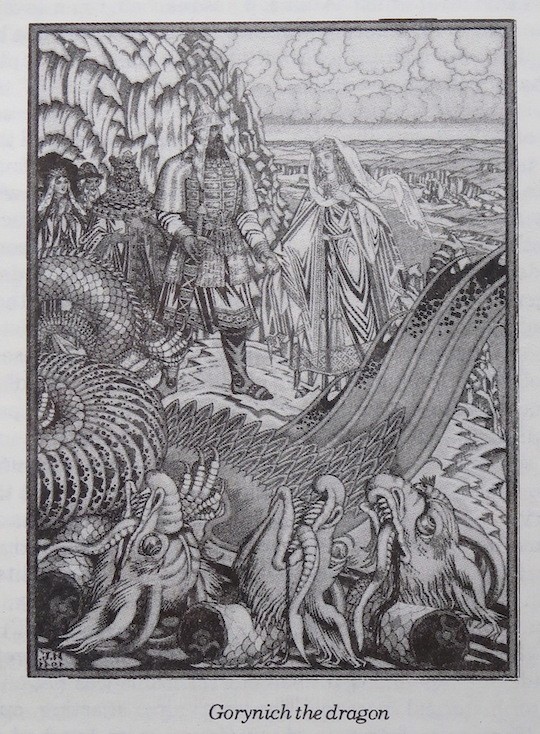
The insanity consists of the fact that our people created an idol for themselves and with exclamations of joy began to dance around him. Believing that he was immortal, they hoped through their love for him to find the source of creative energy. The idol, even when alive, was undeserving of these strong feelings. He died, and simply became a wax mannequin. It is possible that after his death, a massive sobering could have taken place. However, at this point a many-headed monster appeared on the scene. It pronounced itself as the top guardian of the idol’s altar which exudes his living spirit. It was the only fully powerful receptor of this spirit and the legitimate heir to all the wealth of his teaching. This monster has many names now: “the system”, “the Soviet power”, “partocracy”, “communiacs”, “the ruling bureaucratic apparatus”, yet they are all imprecise. The best name to call it is Gorynych the Dragon. On behalf of the immortal VIL, this serpent continues to suck the juices from our souls, and we lack the determination to protest. The symbolic idol created by us still holds us in its hypnotic trance. Besides, despite the primitiveness of its spiritual make-up, the dragon showed great foresight at the right time. When we experienced post-revolutionary euphoria, he, supposedly for our own good, took away all our property. His monopoly of ownership binds us in this way as well. It is difficult to explain to someone who has not lived under it how disgusting this yoke is. Once Saint Seraphim of Sarov was asked if he had ever seen demons. “They are hideous,” said the righteous one, and left it at that. Apparently, the human tongue has no words to adequately describe demonic hideousness. In exactly the same way it is impossible to describe in words the baseness of Gornych the Dragon, who forces tribute out of us. Many have attempted to do so – immigrant historians, dissident journalists, anonymous writers of anecdotes, novelists such as Orwell and Kessler. But for those who have not experienced the dragon’s claws on themselves, these descriptions bounce off like peas from a wall; here I am not even speaking of those Western liberals who partake of all the benefits of the free world and yet glorify socialism. These hopeless idiots would be set straight only by a newly materialized Lenin, who would begin to free the working class from exploitation in their country. Here I am speaking of people who are more or less reflective and able to empathize to some extent with someone else’s calamity. Even they cannot understand us fully. Nevertheless, though it may be one voice in the desert, we must scream over and over again to the whole world about the hideousness of the serpent and warn people against captivity by him, like it or not, “dripping water can drill a rock.” Maybe sooner or later, they will understand something.
What is hardest to endure is the fact that the serpent is not satisfied with what is rendered to “Caesar”, but demands that which is God’s. It is not enough for him to steal from us in a way that no capitalist would ever dream to steal from his workers. He also wants us to consider him our benefactor, a loving father. He wants us to open our hearts to him, to share with him our most ardent desires, to give to him what is warmest in our souls, to say kind and gentle words to him, to show him our adoration, express delight at his incredible sophistry, regard every word of his as divine revelation, to thank him for the wonderful life he has given us, to dedicate our best poetry and songs to him. In short, he wants our sincere love. But he forces this sincere love out of us. Can anything be more unnatural and degrading? The fate of our nation can be compared to the fate of an unfortunate woman who was deceived into marrying a cunning monster, who after the wedding demanded tender feelings from her through beatings and threats. This is far worse than marriage for profit and even the multitude of so-called marital relations by agreement, i.e., prostitution, in which a woman simply conscientiously fulfills her marital functions, thereby supporting herself financially. Still, she is not forced into something more than this, something which is outside the bounds dictated by the mutual agreement. But here her very soul is manipulated, dirty paws reach for what is most private – usurping her inner world.
One who has not experienced this will ask in disbelief: how can anyone force a person to love him? One who is forced to love only fakes such love. In that case the love is not genuine, for real love arises spontaneously, is born in a mystical and unpredictable way within the innermost depths of our “self”.
This lack of understanding is based on a simplified conception of man. In reality, man is such a complex creature that he fits no theoretical model. It turns out that despite the view of psychologists, he can come to love someone not out of an inner choice, but by external command, provided that this command is supported through corresponding measures, or tools. These are exactly what the serpent employed.
What were they? Oh, there were many. Let us speak only of three. The first and most simple tool was fear. Everyone wants to live. When you know that if you do not develop a great liking towards the serpent, they will come during the night, drag you out from your apartment, torture you in the jails of the secret police, shoot you out like a dog, or send you to work at the mercury mines where all your teeth will crumble to powder, you involuntarily begin to develop that liking. Our organism’s mechanisms of self-preservation have some sort of built-in computer. Unnoticed by us, it sifts through all the variants of behavior, compares their results and seeks the most optimal one, i.e., the safest. After this it begins to create a world view based on that variant. It comes as a surprise to ourselves that suddenly we begin to dislike that which we used to enjoy, and we begin to like that which we hitherto rejected. In the thirties the courts were able to sentence people for crimes such as: “He does not love the Soviet regime,” or “He doesn’t believe in the victory of communism.” In other words, the punishment is not for incorrect actions, but for incorrect feelings, and everyone knew this perfectly well. This is why very deep in the souls of our people this act of self-preservation took place, developing “proper” feelings, i.e., those which increased the chances of remaining alive.
The second tool was falsehood. This is not merely a trait of the serpent, but an attribute which characterizes his very nature. Nideyev, a dissident, found an ingenious name for the USSR: the Empire of Lies. No one has thought of a better name since. Even Reagan’s “Evil Empire” is much weaker, because it is not as concrete. The Bolsheviks began to lie unrepentedly even before the Revolution, for it is precisely through falsehood that they prepared the revolt. But that was child’s play compared to how they lied later. Having gained power, the communists began to attract all the people to the business of perpetuating falsehood. Each adult citizen was required to lie constantly for fear of death: at meetings, at work, in print (if he appeared in print), at lectures, in streetcars, on the street, in the bath house, at the barber’s, in the store, on the beach – in a word – everywhere. There is no exaggeration in the words “for fear of death”. If someone dared to say the whole truth during those years, he would automatically receive the strictest of all punishments. When, as a result of such a lengthy, massive attack on truth, reality and falsehood became confused. The scale of values became deformed. People no longer understood whom they should love, and whom they should hate. And instead of absolute criteria, now relative ones came into play: safety, for example. The third tool was already mentioned. This is the creation of the image of a beloved leader. Although the wax doll lying in the mausoleum was pronounced forever immortal, he could not be used for the arousal of people’s emotions to the same degree as in those years when he was alive. A replacement for him appeared – a reticent Caucasian in a simple field shirt with a pipe between his teeth. Soon his image was fused with the system as securely as the image of VIL. One of the first to note this was Henre Barbusse, by making the famous statement: “Stalin – is Lenin today.” Of course, the second leader was also not a serpent. Like the first, he was merely an idol. But as we know, the existence of an idol is tremendously important for the serpent. People find it easier to bow down before something personified. They began to bow to the system not in abstraction, but in the person of Comrade Stalin.
In this way Gorynych the Dragon achieved the goal which he had set for himself from the very beginning: he created a new man. The novelty of this individual consisted in the following: he was able to love that which was unnatural for the former man to love. He believed that which the former man would have thought to be complete insanity. In our country there appeared not a few, nor a hundred, but millions and tens of millions of people who grew to love the Soviet system which robbed them. They believed that at some point everyone would be able to enter a store and take anything they liked free of charge. Yet, the years went by, and the second idol died one day. At first, they heatedly declared that he was forever immortal and placed him in the same mausoleum. Afterward they realized that if the pair, embalmed Lenin and living Stalin, makes any sense, for the second fulfills that which is lacking in the first, then the pair – embalmed Lenin and embalmed Stalin – is an absurdity. Both corpses simply could not be “more alive than the living”. Having acknowledged this, the serpent threw the second corpse out of the mausoleum and began the long process of its dethronement. It became apparent that it was advantageous to make an anti-idol out of one of the idols. He could then conveniently take on the role of scapegoat. To kick this goat around has become very fashionable now. This is currently appealing, since the dragon has grown old and is not as frightening as before. Many have become brave and feel the subconscious need to escape
from his power. Yet the concepts in their minds are still confused, and they mistakenly see the dragon as Stalin. Condemning Stalin seems an achievement of freedom. Yet this is not freedom at all. One can speak of freedom only when we again have personal access to the tribute which has been paid to the monster for so long. This has not happened as yet. We are still living in a spellbound empire. This can be seen even from the outward signs which correspond, to a surprising degree, to those in the fairy tale. What is most obvious to the fairy-tale hero when he first finds himself in a country cast under the serpent’s spell? Firstly, he sees an extreme form of material poverty; secondly, economic failure, which is evidence of general apathy; thirdly, fear and constraint on the part of its citizens, who answer the questions of the foreigners with programmed phrases. If they do reveal the truth, it is only in whispers, having looked around first. This is exactly what we have! This is especially apparent when one returns home after a trip to the West. There one was surrounded by plenty; life was in full swing, people’s faces were open and well disposed. There one gets a feeling of being in a colorful and resounding tropical forest. Here, one automatically enters the desert. This contrast must be felt even more deeply by the foreigners who visit us. Metropolitan Vitaly, the primate of the Russian Church Abroad, summarizing the accounts of Orthodox Americans who have been to the USSR, writes: “The mass of Russian people are nervous, tense, and often harsh. One seldom sees a simple, kind smile on a face, nor does one hear spontaneous laughter.” One need not speak of the shortage of an assortment of stores, lack of services, filthiness of entrances to buildings, the trash which accumulates in the telephone booths and other such things. This creates a picture of abomination and desolation. This visible desert is but a reflection of the desert in our souls. The emptiness of our silos and storehouses is the result of the shallowness of our inner selves. And it is precisely this which is the greatest tragedy of contemporary Russia.
The human “self” consists of three integral parts: inner freedom, our intimate perception of the world, and independent thought. In short, they are termed the will, feelings, and intellect. If you take away any one part, the individual is destroyed. And our serpent takes these away, if not totally, then at least partially. For this reason we have become second-rate people, damaged beings.
By giving the serpent part of our inner freedom, we become passive, lacking initiative, unable to make responsible decisions and take energetic action. We do not undertake anything on our own, for we depend on the serpent. Having paid him the tribute through our will, we expect him to deal with it in some way. We forget that he is not a personality and therefore cannot utilize this personalized instrument. In the long run, economics begin to slip downwards. Let us say, for example, that in Moscow thousands of railway cars are standing right now with goods destined to be sold, but the stores are empty. In any other normal country the citizens would have rolled up their sleeves, and, singing, would have emptied the railway cars, and everything would be normalized. Yet it doesn’t even enter into our minds to do this. We will complain loudly about the situation which has developed but will do nothing to improve it. And psychologically, this is totally understandable: since we have given part of our will to the serpent, let him use these compiled resources of will for the solution to all our problems, the emptying of railway cars included. Since each concrete problem needs to be solved by someone, we comfortably assign the job to the same person whom the serpent has picked for this job: the minister of transportation, Connorev. But even if he were Sean Connery, in the role of superman James Bond, he still could do nothing. For him, as for all of us, the serpent is but an external entity whom he cannot reach. It is important to understand a simple truth: the serpent also rules over those of whom he consists. He collects tribute from everyone, from the last clerk to Rizhkov and Gorbachev. The country’s leaders are also constantly complaining about objective impediments, inertia, “certain powers that be”, sabotage, “enemies of perestroika”. The urge to personify evil lies in the very nature of man. However, they are unable to give even one concrete surname. The point is this. The starry-eyed creature which all of us have raised together has no name.
By rejecting the intimacy of our perception, we lose the treasured ability for artistic creativity. It is wrong to think that this is a need only for poets and artists. Such creativity is one of the main routes to knowledge for any person. The unique gifts of each one of us are revealed in our creation of a specific image of the world which surrounds us. This manifests the special characteristics of our souls and the uniqueness of our individual natures. This self-revelation of a personality type has great significance for each individual, as well as for all of society. Only it can give a person the feeling of living life to the fullest, of satisfaction from his activity, that is, to achieve what we call happiness. If, however, this is not possible, the person becomes angry, he dislikes everything, and no one can please him. Inside him pessimism and bitterness build, and he becomes the type of man which Metropolitan Vitaly described. Under the serpent such self-expression is impossible, for in sacrificing to him the privacy of his inner world, a man loses the capability of formulating that world according to his own desires and begins to accept that which is being imposed upon him by the serpent. In this sphere the serpent can impose only that level which he himself has reached, i.e., a level slightly higher than that of an amoeba. The claw has caught, and the bird is in peril – and all of us are forced to love that which our reptile captor loves, and hate that which he hates.
This invasion of the scaled appendages into our concealed laboratory of feelings was, it seems, the most frightening of all the scares which our period of captivity has brought us. We were all found to be involved in the petty intrigue of fractional arguments which the Bolsheviks cannot forget about. Some obscure offenders, such as the good-for-nothing Kautsky grew in our eyes to the proportions of grandiose demonic figures such as Lucifer, subject to eternal damnation by our progeny. All the actors in world history were divided by the serpent into the “bad” and the “good”, between whom a great chasm existed. Since there were a lot more in the first category compared to the second, we were trained in the feeling of hatred. However, even the “good” were not all the same and created a clearly delineated hierarchy. In particular, those who lived before the appearance of Marxism, even the smartest ones, were seen only as good manure which prepared the ground for the appearance of people who lay hold of this great teaching. Yet there was one category of people which stood apart throughout the epochs of history and its formation. In the frozen soul of the dragon an endearing feeling was reserved for them. These were the famous historical bandits: Stenka Razin, Ivan Bolotnikov, Emelian Pugachev, Salavat Ulaev, Grishka Kotovksy and others like them. We were supposed to react with awe and wonder to these murderers of souls. And this system of preferences, turned inside out was imposed upon our consciousness not only in our attitudes to historical personalities, but also affecting our moral principles. The commandments of the Gospel were laughed to scorn. Marital faithfulness was considered a bourgeois anachronism, philanthropy – hypocrisy. Jealousy for someone else’s well-being, however, received a theoretical basis in the teaching of the inevitability of class struggle. The slogan, “steal that which has been stolen”, showed the path to its practical realization. The lamentable result of all of this was not only millions of crippled souls, but the demise of our great culture. For a genuine culture can arise only through the artistic interpretations of external impressions by a sovereign individual soul, which strictly preserves the values natural for a human being.
Finally, giving the dragon a part of the independence of our thought, we give birth to a frightening thing, namely, pseudo-science. In the area of the mind we bring into action the same processes as we did in the sphere of the will and feelings. At first we voluntarily nurture one of the serpent’s heads. Later, it forces us to feed it. Pseudo-science represents something akin to a cataclysmic disaster only exponentially greater. The loss suffered in a drought or earthquake is associated only with its results. Society does not spend money to create them. Pseudo-science demands spending on its own creation, and then causes damage through its own activity. This loss is a combination of the creation of harmful elements and the lack of beneficial ones. In the first category are the constant “mistakes” of science – the ones like Chernobyl, air pollution, the destruction of rivers by dams, and many other things that we need not mention, since this is all publicized by the “greens”. It need only be pointed out that in our enchanted nation these “mistakes” are much more numerous and their scale more massive than anywhere else. The second evil, which may be even worse is that this pseudo-science, parading under the banner of genuine science, has convinced us that its methodology of gathering knowledge is universal and therefore it is omnipotent. We have begun to treat it as a panacea for all our trials and woes. We have developed an acute reflex: if difficulties regarding certain questions come up, then we must create a commission to solve the problem, or at least an academic commission to study it. This system often reaches absurdity. For example, when nationalities began to attack each other in the Caucasus, we began to explain it in the following way: our specialist on national relations overlooked something, missed something or did not research or think the question through thoroughly enough. They are immediately called upon to make recommendations in solving the problem. Such complaints were noticed even in government statements. No one noticed the absurdity of such tactics. No one wondered what science has to do with this. Can it be true that Ph. D.’s need to sit down with graduate students to perform some magic and present recommendations, and because of this the Armenians will stop insisting that Karabakh is historically their land and the Azerbaidjanis will decide that they no longer need it? Deliberating in this way can lead one to think that such unfortunate phenomena as Hitler’s rise to power and the development of Stalin’s personality cult happened solely because of an oversight by experts.
If we placed our hopes on science only in special situations, that would be plenty. But we have entrusted our everyday fate to it, for at the very core of our national economy we have placed the principle of scientific planning. Moving across an unfamiliar city with a complicated combination of streets and rapidly changing environs, we program five years in advance at which moment we should move the steering wheel of our car. It is no wonder that it constantly collides with some obstacle, and lately it seems that it has stalled completely.
Having transferred all business needing the involvement of intellect to an external entity, which we call “science”, we completely lost our ability to use our own minds. As a result, the worst possible thing took place: names were separated from their essential meaning and became entities in themselves. This means that we transferred ourselves from a world of comprehension to a world of sounds. Pronouncing a certain word, we take it in as a musical chord, which brings forth a certain set of emotions, but we do not bother with its definition. To illustrate, the very word “science” itself can be used. It evokes positive feelings from us, and is associated with something useful and needed. Yet we do not trouble ourselves to remember the definition of this concept and to check whether contemporary “science” really does fit this definition or not. If we were to do that, we would immediately see that it does not. “Spirituality”, “mercy”, “democracy”, “socialism”, “the potential of socialism”, “economic reform”, “new thinking” are further examples of popular contemporary senseless sounds.
In general, no matter how sad this may be, we must admit that we have become deficient in all three spheres of our soul. We have lost our once lofty, human qualities. And in this lies our greatest calamity. And of course, anathematizing Comrade Stalin will not mend the situation. In this pastime we have found a new form of external self-expression but have remained the same inside. A broken record player will not become a good one if you simply change the record. “Stalinism”, which we now amicably condemn, is just another meaningless sound for us, as is “perestroika”. The only difference is that the sound “stalinism” does not comfort but irritates us. This is not what we need to do. We need to do something totally different. We must free ourselves from the serpent.
But is this possible?
We have no right to answer this question in the negative, or we shall fall into despondency and will resign ourselves to eternal captivity. Other peoples did shake free of this lot. Oral folklore gives evidence of this, as well as written sources, such as the Bible in particular. Are we worse than they? Such evidence should give us hope and activate us. The experience of these peoples is precious for us, and the subject of the struggle against the serpent should become the subject of intense study and contemplation.
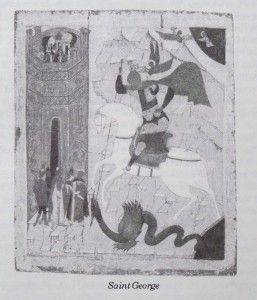
Summarizing the available material, it can be determined that historically two variants of emancipation from the yoke of the dragon exist: the quick one and the drawn out one. In the first variant a foreigner comes to the enchanted land. Expressing surprise at the fact that so large a tribe gives this abominable creature the best of everything, even human lives, he fights the serpent one to one and conquers him. Here one must pay attention to two important facts. Firstly, the emancipator is always a newcomer to the land. Secondly, he acts against the serpent in most cases not with power, but with his mind and his knowledge. These factors can be illustrated by three classic examples. Oedipus, although he was born in Phoebes, as an infant ended up in a foreign land and grew up there. Thus, when he came to free the city from the sphinx, neither he nor the citizens knew that he was not a foreigner. He conquered the sphinx by guessing his secret. The afore-mentioned Daniel, after destroying the cult of VIL took on himself the mission of fighting the dragon. He said to the king, ‘’I shall slay the dragon without staff or sword” (Daniel 14:26). He took some tar, fat and hair, cooked this and having made a ball out of this mixture, threw it into the dragon’s jaws, and it burst asunder. And Daniel said, “Here is what you deemed holy.” And, as it was meet, Daniel was not a Babylonian. And now the most famous of the Christian fighters of the dragon: St. George. His conquest of the serpent is quite mystical: having made the sign of the cross, he approaches the monster and does something to him which results in his becoming tame as a lamb. The princess who was to be sacrificed to the serpent takes him into the city tied like a dog. What is the interpretation of these two characteristics of the liberator?
The key is given by St. George. Although he lived in Lebanon, where he conquered the beast, for the emancipated people he was still a foreigner, his “miracle of the dragon” happened long after the year 303, when he suffered a martyr’s death. He was foreign in the sense of being of the next world. For the citizens of Beirut he was a local saint, a martyr. There is the first characteristic of the dragon fighter. The second characteristic flows out of the first. He conquers by the power of the Holy Spirit. One can be certain that in their peril the Beirutians were praying to St. George, asking him to intercede for them before God, to help free them from the serpent. And the prayer was heard, and deliverance took place. God forgave them the sin of idol worship, from which the captivity by the serpent always begins, and sent them help through their own intercessor, giving him invincible power. It was by this power that they were saved. Consequently, we have here the following progression of events: SIN – CAPTIVITY – REPENTANCE – EMANCIPATION.
Although this progression is most evident in the life of St. George, it can be seen as the historical underlying cause in other cases as well. Commentators have pointed out a certain discrepancy in the Biblical account of the dragon-conqueror Daniel. The man who was sincerely faithful to the real God did not live in Babylon at the time that the people worshipped the dragon. He lived much earlier, at the time of the prophet Habakkuk. If so, then Daniel, just as George, destroyed the dragon following his own death, that is, as a guardian angel of his people, sent from heaven. And be destroyed him “without staff and sword”, again, with God’s power. Let us add this, that he was also a martyr: he was thrown into a lion’s den. As for Oedipus, we must take into account that the tale about him came to us reworked by Sophocles, who turned it into a psychological drama with shades of moralizing. Its central subject became not the fight with the sphinx, but a biography of Oedipus, who was unable to walk away from his fate. Naturally, he appears in the tale as a live person. But the character of his conquest of the sphinx remains spiritual in Sophocles’ rendition, as it must have been in earlier folklore. And again he is a martyr, and what a martyr at that. He is tormented by his conscience, blinds himself, etc.
The progression of the second variant reveals itself more fully in the Bible. We know that Daniel threw the ball into the jaws of the dragon, and he burst. However, the affair did not stop at this. The priests grew angry and forced the king to give Daniel as food for the lions. The former cult was reinstated and the people continued to suffer and cry. Its groanings are told by Prophet Jeremiah: “Nebuchadnezzar the king hath devoured me, he hath crushed me, he hath made me an empty vessel, he hath swallowed me up like a dragon, he hath filled his belly with my delicate meats, and he hath cast me out” (Jer. 51:34). The attempt of Daniel to free the captives was unsuccessful, and the reason for this failure was that there was insufficient repentance in the land. Only a minority turned to the living God. The others continued to worship idols, replacing the old ones with new ones. And then God was angered, and the fate of Babylon was decided. Speaking of this decision of the Lord, the prophet says: “And I will punish Bel in Babylon, and I will bring forth out of his mouth that which he hath swallowed up. And the nations shall not flow together any more unto him. Yea, the wall of Babylon shall fall” (Jer. 51:44). God allowed Babylon to be subjected to severe punishment, the physical destruction of the city. But was God merciless to the ones who had remained true to Him in Babylon? No, He did have mercy on them and showed them the path to salvation: “My people, go ye out of the midst of her, and deliver ye every man his soul from the fierce anger of the Lord” (Jer. 51:45). The instruction is so important, that it is repeated in another place: “Flee out of the midst of Babylon, and deliver every man his soul. Be not cut off in her iniquity: for this is the time of the Lord’s vengeance” (Jer. 51:60). Thus, the progression of events here is as follows: “SIN – CAPTIVITY – INSUFFICIENT REPENTANCE – GOD’S WRATH – THE PERDITION OF THE MAJORITY AND SALVATION OF A “SMALL FLOCK”.
This variant is frightening. Here blood is shed, people perish, relatives and close ones are separated, the accumulated wealth is dispersed. This is a plain reminder of the last times, a “minor Apocalypse”. Nevertheless, this is emancipation. The disease has simply gone so far that the ailing society can only be healed through surgery. In this case even God Himself cannot save the entire nation, for the nation does not want to be saved, and therefore this chance is given only to a part of it. A completely different strategy of behavior is demanded from this point, however. In the first variant people had to keep together. Here they need to leave the condemned kingdom one by one, for through the mouth of a great prophet God twice has said, “Each one save your soul.” This should be understood spiritually, not materially. Here we are not speaking of emigration to another country, not having turned to the loving God. Here we mean that on an individual basis, not looking at others for guidance, we should stop paying tribute to the serpent. One need not leave the territory — one must exit from the herd of idol worshippers which is moving towards inevitable perdition.
I eagerly study what goes on around me, listen to conversations of my co-citizens, catch the intonation, attempt to decipher the expressions on their faces. I do all this in order to understand: what is it like today, the spirit of our Russian nation? Do we have repentance on a massive scale, giving us the hope of a bloodless emancipation from the dragon, or must we prepare ourselves for a worse outcome?
I very much want to see signs of such repentance, but I do not see them.
The first sign ought to be a general prayerful supplication to a heavenly patron. Do we have one? This role cannot be fulfilled merely by a deceased countryman, or even by any saint. He must simultaneously fulfill a number of criteria: He ought to have lived a clean, righteous life, been direct and noble in his actions, with unlimited courage, an irreproachable Christian, possess a flaming faith, profoundly understand the misfortune of his country, have a boundless love for his country and people, and witness this love by dying a martyr’s death for it. In addition, he must possess an extra element of grace. And we have such a person who fits this description: our last ruler, the Anointed-of-God, Nicholas Alexandrovich. In him we could have an ideal intercessor before God, which one could hardly find in any other nation. However, this treasure lies wasting. We are not using it. Not only do we not understand what a saint this man was, we do not even feel simple human respect for him. Without thinking, we repeat all the hideous slander which was invented and spread about by the destroyers of Great Russia. They knew very well the in order to destroy, one must first dishonor the “Restrainer”. It is still heard that “Nicholashka” was dumb, and if not dumb, then weak-willed; that he was under the influence of a giddy wife, that he did not discern the charlatan in Rasputin, etc. And this is said not on the basis of learned facts but in spite of material, now readily available to everyone, refuting this point of view. People can’t be bothered to read this material, for, God forbid, it might force them to reassess the stereotypes which they have become accustomed to.
The second sign should be the cessation of idol worship, yet it continues. For almost seventy years now, on the square which was sacred for our ancestors, which they named Krasnaya, or Beautiful, lies the dried-up mummy of a paralytic, who had no talents save his beastly hatred for Russia. At the entrance to his tomb an honor guard, consisting of Russian youth, changes every hour.
In all of our cities the main streets are named after his pseudonym. In countless halls where meetings, dances, and concerts are held, his bust is present or his portrait hangs. Even in our present era of “glasnost” all that the most courageous speakers can do is cast a shadow of doubt on his 100% correctness on all issues. Others confine themselves to finding common ground with him on some question, trying to bring him over to their side through the back door, thereby strengthening their side through the back door, they’re strengthening their own position. This shows that we have not come out from under the hypnotic trance of the idol’s name.
The third indication of general repentance of our people should be the growth of hatred of socialism. But even this is not visible. The maximum which we have here is the condemnation of “bureaucratically controlled methods of governing” that is, not the serpent itself, but his accomplices. This is seen even more clearly given the background of what Drocesses are happening in Eastern Europe and some of our republics. There they are taking down statues of Lenin, renaming streets and enterprises which were named in his honor. They are firing communist parties. People are taking to the squares with anti-socialist slogans, the prohibitions on private ownership are being lifted, land is being returned to the peasants. Everything there is boiling and seething with indignation. The people’s patience has blown up and they no longer want to pay tribute to the slippery reptile. They will no longer fall for the story about “The only true teaching”. Even the Ukraine is beginning to raise its voice, but in poor Russia things are still quiet. And behind that silence one suspects the fear of parting with socialism. The fear is – maybe some sort of exploitation will start once it’s gone? We do not notice when Gorynych the Dragon pulls ten skins off us. Yet if private entrepreneurs, who because of competition will be forced to keep their income on a reasonable level will start to make money on us-—that frightens us. Although it has always been merciless with us and brought our country to complete ruin, “Socialism” continues to be associated in our spell-bound consciousness with something good and humane. An obvious characteristic of the “New Man” raised by the serpent is that he licks the paw that beats him.
This all brings us to the conclusion that we have INSUFFICIENT REPENTANCE. And what comes after that we already know: GOD’S WRATH.
At this point many readers will say that it has already happened. Yes, they say that the Russian people fell into sin. They were hooked on the promise of an easy life, forgot God and the testaments of their ancestors, but they paid for this with a million sacrifices lives. Now, on their blood which was shed, a new Russia must arise. No, these sufferings were not sent by God, but were caused by the serpent to break us and to make us his silent slaves. As seen in folklore, sometimes this terrorizing by the serpent was enough to bring a nation back to its senses. Unfortunately, that is not our case. Which means – and the tongue does not want to move to say these words-—the real punishment still lies ahead of us.
There have already been omens which show that it will be the same as described in the Bible. “Thus saith the Lord: behold, I will raise up a destroying wind against Babylon and them that dwell in the midst of them that rise up against me. And I will send unto Babylon fanners that shall empty her land for in the day of trouble they shall be against her round about” (Jer. 51:12). And what is happening now? Obviously powers are preparing to scatter Russia, as its own worst enemy, in the Caucasus, and in other places.
There is yet another weighty fact. In our society there has suddenly arose unnoticed a brand new category of people: young, newly converted Christians. Usually they have many children, have spiritual fathers, attend church regularly, and the whole family takes Holy Communion. They exchange spiritual literature and icons amongst themselves. It is characteristic that a relatively high percentage of them are highly educated (let us remember that before the revolution the intelligentsia consisted almost totally of atheists). One can recognize them even by their faces: bright, kind, full of spiritual beauty. And one cannot look at the youngsters who open their little mouths for the acceptance of the Eucharist without wonder and joy. There it is, our hope! And this is not only a joyful, but a dreadful phenomenon. In fact, before our very eyes an abrupt polarization of society has begun to take place, in result of which a SMALL FLOCK is beginning to form. That is what is meant to take place before God’s vengeance. As it is said in the Revelation of St. John the Theologian: “He that is unjust, let him be unjust still; and he that is filthy, let him be filthy still; and he that is righteous, let him be righteous still; and he that is holy, let him be holy still” (Rev. 22:1 1).
They are not many in number, our wise ones, who providentially have come out of the large flock which is heading for the abyss. But now our discussion of the future of Russia should include only them. The others have already been sentenced to removal from the historical scene. And my present article has been written only for them. If someone has read it who does not belong to them, he has only wasted his time. But to my dear wise ones I will say this: hold on to your line of action, do not be put off by anything, fear nothing. Do not walk in the counsel of the ungodly, do not be tempted by political passions, do not participate in the battle of the parties, do not believe a single word of the serpent, for he is a liar and the father of lies. Do not give him a single part of your being, protect your sanctified inner freedom, love that which indeed is worthy of your love, believe in your good judgement and do not succumb to the crafty suggestions of pseudo-science. Give Caesar only what is due Caesar, but that which is God’s preserve in your souls. And when God’s wrath descends upon us, pray hard for our much suffering land. And then the Lord will show His miracle and will preserve you in the midst of the flaming country, as He once preserved Ananias, Mishael, and Azarias in the fiery furnace. And when it is all over, you will become the kernel of the Russia that is to come, and that greatly blessed wondrous land will appear on the surface out of your souls as the city of Kitezh to the wonder and admiration of the whole world, even if territorially it will only be the size of the Muscovite kingdom of Dimitri Donskoy. That indeed will be emancipation from the serpent.
Moscow, January 1990, V.N. Trostnikou
Translated by Matushka Naumenho