Author: orthodoxaustralia

  • Archimandrite Constantine Zaitsev: On the “social gospel” of ecumenism

    Concerning the author of the text below, Fr. Seraphim Rose stated: “Archimandrite Constantine Zaitsev of Jordanville was a brilliant thinker who, being fully within the tradition of the Church, was able to see beyond the externals and into the heart of the Orthodox faith, wherein lies its mystical, unseen essence and its living apostolic power.”

    The following is excerpted from “ Ecumenism, Communism and Apostasy: The Spiritual State of the Contemporary World” by Archimandrite Constantine of Jordanville:

    “The forefront of church-social life is occupied by so-called ecumenism. It’s task is to unify “Christianity” through a horizontal agreement, with a devaluation of any historical churchness. Openly, the task is not posed as one which would give rise to an image of some Super-Church (at least not as early as 1960! – ed). This would scare away everybody and be unworkable in any case: ecumenism has no Church-constructive capabilities. But in a scheme of destruction its opportunities are tremendous. And this all the more is so, since in its destructive activity the ecumenistic movement is leaning on general strivings peculiar to our age.

    One can distinguish 2 pernicious ideas here. The 1st is the negation of the Church as an unrepeatable historic entity, as the Body of Christ, with the resultant transformation of churchness into a matter of free agreement inspired by self-willed fancy (the “Relations” document of Crete comes to mind – G.I.) . The 2nd is the transformation of Christianity into an entity of this world, with the resultant transformation of even its final attainments into something unifying humanity on earth (the “Missions” document of Crete comes to mind -G.I.) , and elimination of the perspective of a twofold Eternity – that of blessedness or damnation…

    In the contemporary Protestant world (and elsewhere – G.I.) … for Christ’s sake the Church has to become “contemporary”, including within itself all social matters and fusing them…

    What remains is an ecumenistic dream resting on human agreement concerning the utilization of various forms of worship of God. A clerical “social-contract”! There is nothing more of Christ in this design, creeping and serpentine in its expressions, whose incomprehensibility is concealed by an outward appearance of good intention…

    We have before us an expressive declaration of the Moscow Patriarchate … which has reached us. What do we read here? “We, the Orthodox Faithful, are expressing tremendous satisfaction that the Soviet government is maintaining those very same positions, carrying through a positive politics of cementing friendly relations between people of the whole world, offering to general consideration ever-new positive positions which could serve as a basis for the creation of common security from armed attacks, as well as from threats to the well-being of humanity from tests of atomic warfare. Human reason, whose power according to Christian conception is in its likeness to Divine reason, through various ways not always logical, comes to healthy reason. And where according to the established conviction of certain people there are no points of contact, the concern for the future fate of humanity which inhabits the earth brings both those whose faith lies in the Providence of God and those who lean only on materialistic conceptions to a common aim. And this aim is to find a common language and full mutual understanding, in order to preserve the human race and direct it into a stage of well-being, created by working in all fields of activity available to humanity. To our great fortune, our government also has this point of view. ‘The correct way for questions of peace, both for Christians and atheists, is one: to live in friendship and to do everything in order not to allow the rule of Evil on earth’ – these are the words of the head of the Soviet government, N.S. Krushchev (Izvestia, February 25th, 1959).” – (Notice that faith in Christ and repentance are not mentioned as the only conditions which could lead to true peace! – G.I.)

    What then is the all-inclusive task for a “sovietified Christian” consciousness? The setting up of a state of well being on earth, realized simultaneously by both the faithful and atheists. But this is precisely the contemporary task of the communists! In addition, for both these and the others there exists a kind of common “evil”, opposed to both, with which they are jointing struggling.”

    —————————————–

    Fr. Seraphim Rose likewise stated (among many other things on this subject matter): “…we have seen a reform of Christianity that does away with the Church as an instrument of God’s grace for men’s eternal salvation and replaces it with the ‘social gospel’.”

    Metropolitan Augoustinos (Kantiotes) of Florina has this to say on these matters: “Do you not hear the voice of the serpent, seeking to corrupt the minds of Orthodoxy, leading us away from our simplicity? Here is what the serpent says: O, Orthodox Church! Why do you keep your distance? Why are you afraid of me? I am no dragon; I am a sweet angel bearing the message of love. I am not going to hurt you. Keep your dogmas and your traditions. Leave these things to the theologians…I invite you into my room to discuss other matters. Let us make a common stand against hunger, against poverty, against atheism, against communism, against war. Do these matters not move you? Does this proposition not excite you? Come then, let us begin our conversation on high, on the level of ecumenicity, on the level of mutual understanding. You will see just how beautiful our coming together can be!”

    And Constantine Zalalas further elaborates that “the dominant trend … (is) for the various Christian confessions to work (together) so as not to be seen as divided before (the) non-Christians as a result of doctrinal differences and to further show unity by placing a priority on issues of social justice and oppression of social classes. In other words, these Christian denominations said ‘look we cannot get together on doctrine, we cannot resolve our differences, at least let’s put those aside and lets work together on social issues – on helping the poor, on creating better opportunities for poor nations, and fighting the oppression of social classes.’ But what is wrong with this? … This steers the missionary and preaching efforts to give 1st priority to the formulation of methods of restoring social injustice as opposed to spreading the truths of the gospel … The basis and the prospect of contextual theology was the conversion of missions into a “community of churches in mission”. But in Orthodox theology we do not have a “community of churches” – we have the One, Holy, Catholic and Apostolic Church. The appearance of Christian missions emerging from a community of “churches” degrades the One Orthodox Church to one denomination of these many Christian factions. So, it does not reveal the one truth and further degrades missionary work to a sociological instead of soteriological (related to salvation) perspective.”

  • St Nicholas Velimiriovic: “And now you decide: do you want to be with the dark and putrid Europe or with Christ”?

    (Excerpts from St Justin Popovic (+1979), “The Orthodox Church and Ecumenism”, published at Hilandar Monastery, Holy Mount Athos, in 1975)

    St Nicolai Velimiriovic

    St Nicholas Velimiriovic (+1956) says: “On what side do you want to be, with the darkened and rotten Europe or with Christ?”

    If the history of the last three centuries (the 18th, the 19th and the 20th) would have been called with one and fitting name only, it must have been that of “the protocol of the trial between Europe and Christ”. All these because in the last three hundred years everything that happened in Europe was against Christ:

    Christ says to Europe that she is baptised in His Name and that she must remain faithful to Him and His Gospel. To that, the accused Europe answers: “All religions are equal. The French encyclopaedists told us so and besides nobody can be forced to believe one thing or another.”

    Europe tolerates all religions as popular superstitions, for the sake of her imperialistic interests, but herself does not follow any. When Europe will reach her political targets, she will quickly finish with these things.

    Christ is asking painfully: “How can you, human beings, live only with your imperialistic and materialistic intentions that are only with your animal-like will for bodily food? I wanted to make you gods and sons of God, and you run away, pursuing to become like beasts under yoke.”

    To that, Europe answers: “Thou are outdated, instead of Thine Gospel, we discovered zoology and biology. Now we know that we are not Thine inheritors and not the inheritors of Thy Heavenly Father, but of the orang-utan, the gorilla and the monkey. Now we are completing ourselves to become gods, because we don’t know other gods, but us.

    St Iustin Popovic

    Christ says: “You are more stubborn than the Jews of the old. I lifted you up from the darkness of the barbarian age to the Heavenly Light and you go back to darkness, like the blind to a filthy dust. I shed My Blood for you. I showed My Love to you, at a time when all angels turned their heads for not suffering the smell of your hell. So, when you were just darkness and you were rotting, I was the Only One to clean you and to light you. Don’t be unfaithful now, because you will go back again to that unbearable darkness and stench.”

    Europe, smiling with superiority, shouts: “Run away from us. We do not know Thee. We follow the Hellenic philosophy and the Roman civilisation. We have universities. Science is our guiding star. Our emblem is: freedom, fraternity and equality. Reason is the god of gods. Thou are an Asian. We deny Thee. Thou are just a fairy tale of our grand fathers.”

    Christ, in tears, says: “Now I leave, but you will see. You left the God’s Way and you went on the way of Satan. Blessedness and happiness were taken from you. Your life and your death are in My Hands, because I gave Myself to crucifixion, for you. In spite of that, it is not I Who shall punish you, but your sins and your fall from Me, your Redeemer. I showed the love of My Father to all mankind and I wanted to save you all through love.”

    To that, Europe says: “A healthy and manly hatred against everyone who is not agreeing with us, this is our program. Thy love is just a fairy tale. Instead of this, we raised the flags of nationalism, internationalism, statism, progress, evolutionism, scientism and culturalism. In these we find our salvation, and Thou go from us.”

    Brothers, in our times, this discussion in disagreement ended. Christ left Europe, as He left the land of Gadara when He was asked to do so: but straight away after He left, there were wars, fear, ruin and destruction. The barbarian time before Christianity returned to Europe: that time of the Avars, of the Huns, of the Longobardians and of the Africans, but only one hundred times more frightening. Christ took His Cross and His blessing and left. He left behind this darkness and the horrible smell of that place.

    And now you decide: do you want to be with the dark and putrid Europe or with Christ?

    +++

    The Saint Hierarch was saying these about the acquired blindness of the Western world: “The West sank in its second childhood. In this we can find the monstrosity and its madness. During the Christian epoch, when the West was Orthodox, the West could see with the Spirit and look with her mind, but becoming estranged from the true and good deeds, its spiritual vision became narrower, until it turned into a dark blindness, during the 20th century. Now the West has only bodily eyes to observe things falling under senses. The West armed her eyes with many stunning tools, to see better and closer the felt world, the shape and the colours of things and beings, their number and the distance between them. The West detects with the microscope, seeing the smallest worms, the microbes, in a way that never ever someone could see them before. The West is using the telescope detecting the stars above her home, in a way that never ever someone could see them before.

    But here her sight stops seeing. Regarding the thinking sight and the spiritual eye looking for the hidden parts of things and the understanding and the importance of the whole creation and universe, so regarding all these, o dear brothers, mankind of the West is blinder than the Islamic Arabians, blinder than Brahmanic India, blinder than the Buddhist Tibet and blinder than the animist China. Indeed, Christ did not see a greater shame like this in the two millennia that passed with the baptised man being blinder than the ones who are not baptised!

    The good will Messenger, one with the Apostles (St Nicholas Velimirovic), says about the “White Demoniac” – Europe: “What do you think about Europe? The Africans and Asians call the Europeans the “white demons”. This is the reason that they could call Europe the White Demoniac. White because of the skin colour, “demoniac” because of the darkness of its soul, because Europe denies the Only God and took the throne of the hardworking Roman caesars. And exactly like the Roman caesars before the destruction of Rome, Europe assured all the people on earth that they can worship their gods in the way that they can and want, because they are allowed to do so. But firstly all people (nations) have the duty to worship the goddess of Europe, either under this name or under the name of “culture”. In this way, brothers, Rome resurrected like a werewolf, during these times. It is the satanic Rome before Constantine the Great, the Rome that destroyed Christians through fire and sword, trying to stop Christ to enter Europe. But the “White Demoniac” fell into a much worse illness that the older Rome. Because if the older Rome bowing down to idols was tormented by one demon, the White Demoniac is tormented by seven demons, much worse than that devil of Rome. Here we are with a new Rome bowing down to idols, which is a new martyrdom for Christians. Be ready to accept this martyrdom for Christ, from the White Demoniac…

    The new Europe bowing down to idols does not praise anything “godly” less than her only entity. Europe praises herself, her wisdom and her power. But Europe is like a balloon ready to crack, in the laughter of Africa and Asia. Europe lives in the vicious circle of discoveries. Anyone who presents a new discovery is named genius. And again, anyone who brings news about discoveries is called with a Ph. D. appellative. But none of these discoveries makes anyone a better man, more honest, and more enlightened. Europe, in the last one thousand years, did not bring one discovery of the Spirit, but exclusively of the matter.

    The discoveries of Europe brought mankind on the edge of a cliff. Those discoveries led Europe to a spiritual darkness not yet encountered in the history of Christianity. Because all these discoveries, (we do not know if they are from bad thoughts or produced under Jews’ influence) have been drawn against Christ. When the telescope was discovered for observing the stars, the European scientists put this discovery forward in opposition to Christ. When they discovered the microscope, there was also such laughter against Christ. When they built the train, the steam machine, the telegraph and the telephone, all the air was re-sounding of the self praise of Europe against God and His Christ. When men invented machines to travel over the sea, to fly through the air, to speak remotely, Europe saw Christ as useless as the Egyptian mummies.

    But all these discoveries from the last two hundred years, Europe used for her suicidal in two world wars, for murdering, for hatred, for her fall, for tricking, for raping, for mocking the holy things found in peoples, for lying, for not venerating God, for the lust and the atheism spread all over the world. In reality, Europe did not trick anyone else but herself. The non-Christian people understood what Europe is and what she wills: for these reasons they called her the White Demoniac. Just listen to what David the King says: these ones are proud with their chariots and those ones with their horses, but we will be magnified in the Name of the Lord (Ps. 19:8). Those braggarts will sleep on pillows of lying glory, but we will rise up and we will correct ourselves. And Apostle Paul speaks out with even more strength: “And what has thou that thou deeds not receive? Now if thou deeds receive, why boastest thou as if thou deeds not receive?” (1 Corinthians 4:7). You must know that all the discoveries have been made on earth, which belongs to God, and learn from these both the shame and the honour…

    The numerous nations of Asia and Africa – even if they are not baptised, but with an inclination towards a spiritual life – would have understood and valued these things, because these nations praise their own faiths, their own gods and the books that they believe to be holy: the Koran, the Veda, and so on. They are not honouring with things made by their hands, with their “culture”, but with what they consider to be higher than themselves and with what they see as perfect in this world. Only the European peoples do not praise Christ, and His Gospel, but prising their dangerous machineries and their cheap goods, that is their culture. The result of this type of European worshiping for the famous European “culture” brought hatred towards Christ and Christianity.

    Hating European goods and European people, the pagans also came to hate the True God. But, alas, Europe feels no pain for this! Because Europe herself was the first to hate God and to try to get rid of Him. This is the state not to be invidious about that the whole European mankind was brought to, through its wrong advancement, under the influence of a church found in the wrong, especially in the last 200 years. Not the people are responsible for this but the spiritual guides of these peoples. Not the flock, but its pastor. It could be very good if Europe was to praise Christianity, showing this Christianity as the most precious inheritance… like in the first centuries after Christ – if Europe was one and the same with Christianity, identifying herself with Christianity. Praise Christ God and His Name onto all continents – that was the job that Europe had from God. Without Christ, Europe is the poorest beggar and also the most lack of shame exploiter of this world!

  • A very short history of the St Herman of Alaska English-language mission

    Fr Basil Willow:

    Christ is amidst us Fr. Paul.
    I am so often intrigued by the commentary flying around about Fr Seraphim Rose,
    Especially by those souls who have never met him, nor studied his carefully crafted texts for our times on our timely issues. They speak like they were his disciples or spiritual children, or perhaps vehement enemies because some career clergy/ bishops, did not have it in themselves to compete on Fr Seraphim’s theological & scientific gifts.
    Even more disturbing is the dribble, in the West mainly, that attacks Fr Seraphim’s spiritual Father, Abbott Herman of Platina. As he, Abbott Herman often told us, he literally had to “feed”, Fr Seraphim, in order for the latter to “kill” his western mind & bring it into the realm of original Christianity. No easy task. Today Fr Seraphim is treated like a Saint in Russia, Mount Athos & many other places.
    Good for you Fr Paul to take up the enormous challenge of taking up the continuation of operating the St Herman bookstore on Gerry Blvd SF, next to the huge Cathedral, built by Holy Archbishop John, while we struggled with the Australian bookstore, first on Nicholson St Brunswick, where right accross the road is a Greek Church containing the incorrupt fingure of St John the Baptist.
    Then we moved the missionary bookstore to Auburn Rd Auburn. A suburb close to many tertiary colleges. Today it is part of our Chapel dedicated to St Herman & the Dormition of the Theotokos

    Aboona Paul Baba:

    Hello Fr. Basil+ Yes truly inspiring days in Orthodoxy coming from St. Herman of Alaska Monastery+ We didn’t have much at all in English but from what came from those two hero’s gave us… I remember Fr. Herman visiting you and the Australian bookstore community. I saw Fr. Herman with friends the day he returned to San Francisco and told us stories from his trip – a parrot that talks?. He rushed out from us and said he needed to get to the Monastery quick before they burn it down. He smiled and we took it as a joke. Upon his arrival the Monastery had burned down to the ground. He cried from such saddness.. A hanging lamp cracked from the heat and oil burned up in flames. My Byzantium Gallery on Geary blvd. next to St. John and the Cathedral was very good and some difficulty. I can’t even imagine having Byzantium now knowing all these facebook friends 🙂 I painfully miss those days of elders…Fr. Spiridon, Fr. Metrophanes and the wonderful miracles from God that came in from the people.

    https://www.facebook.com/permalink.php?story_fbid=1864906470459947&id=100008218360484

  • Children of an Age of Martyrs. Monk Herman (Podmoshenskii). Ιn Memoriam (June 30, 2014)

    Monk Herman (Podmoshenskii), Platina, California, Sep 4, 2012
    (interview by Deacon Andrei Psarev)
    Source: ROCOR studies website

    I first learned of Father Herman in Moscow in the year 1989 or 1990. I was friends with Roman Vershilo, now the editor of the web portal antimodernism.ru, and at his place I first saw the first issue of  Russkii Palomnik [Russian Pilgrim], with an icon of Sts. Sergius and Herman on the cover, which was decorated with the colors of the Russian three color flag. This was the first issue of the journal after Fr. Herman’s revival of this well-known per-revolutionary periodical. At the time Roman, together with Stefan Iakovlevich Krasovitskii, was inspired by the establishment of a Moscow affiliate of the Valaam Society of America. Later at the home of Zoya Aleksandrovna Krakhmalnikova I saw some sort of pamphlet from the monastery in Platina. There on the cover was an artistic photograph of the new (post-fire) Platina church in snow, set before a bright blue sky.

    Having become a “conscientious” [сознательный] member of the Russian Church Abroad, I judged Fr. Herman for the turmoil he caused, as a result of which he was defrocked by ROCOR in 1986. I recall that when he would visit the monastic cemetery in Jordanville in the 90’s, the thought would not even enter my mind to show him any kind of friendliness. I recall some American monks, all but schema-monks, standing next to the cathedral in San Francisco during the glorification of St. John in 1994; although, they looked more like hippies than traditional Orthodox monks. Clearly these were Fr. Herman’s recently converted former adherents of the Holy Order of MANS.

    When I arrived at Holy Trinity Seminary in Jordanville, I came across an issue of Orthodox Word in which news was given of some mysterious catacomb bishop from Russia, carrying the title of “Archbishop Leonty of Chile: Confessor of Heartfelt Orthodoxy” – this was all frighteningly interesting for a newly-declared “zarubezhnik [i.e., member of the Russian Church Abroad, lit. one who is beyond the border] from the USSR and I decided to dedicate my graduation thesis to a biography of Archbishop Leonty. Later I wrote to Fr. Herman, asking him to share documents. In answer, I received from him a request to provide him with my materials.

    The next mediated encounter with Fr. Herman occurred in Alaska, in the summer of 2000, when I was looking for work on Kodiak Island during the salmon season. A priestless Old Believer, Petr Ivanovich Basargin, drove me to a boys’ school named in honor of St. Innocent. At that time clergy of “Fr. Herman’s jurisdiction” happened to be meeting to correct their canonical standing and join themselves to the Serbian or Bulgarian Orthodox Churches. In the school chapel it was joyous to hear chants sung at Holy Trinity Monastery at small compline during veneration, only this time in English. And in this positive propagation of the tradition of Russian piety lies the service of Fr. Herman. In 2000 and then in 2001 I visited Fr. Herman’s skete on Spruce Island and the resident monks’ openness, hospitality, and simplicity made the most favorable impression on me.

    Attempts to obtain materials on Archbishop  Leonty were renewed with the now-”canonical” abbot in Platina – Fr. Gerasim. Then suddenly, I don’t remember how, the correspondence with Fr. Herman resumed. In September of 2012, I flew to Platina – it was the thirtieth anniversary of the repose of Fr. Seraphim (Rose); the festal services were led by our Metropolitan Hilarion and on the next day after his service in Platina I arrived there in order to visit Fr. Herman. In Platina I spent a day and a half and during this time I had several meetings with Fr. Herman.

    Fr. Herman’s openness and rare mastery of the Russian language impressed me. He, like Metropolitan Vitaly (Ustunov), had a style, high diction, not just a vocabulary. Overall, there was the feeling that you had found some multi-faceted fragment from the old Russian Church Abroad.

    In his Russkii Palomnik, Fr. Herman attempted to pursue the idea of “Independent Orthodox Workers” (IOW). In the end, this word “independent” brought Fr. German into conflict with his ruling Hierarch, Vladyka Archbishop Anthony, but part of this approach was also that Fr. Herman tried to openly speak about the history of ROCOR, albeit controversially and dissonantly, in this way drawing interest to the complex issues of our recent history. Nevertheless, such an approach was better than concealing problems for the sake of “esprit de corps”.

    I am not Fr. Herman’s biographer and much less so his hagiographer. Suffice it to say that I know of the problems and accusations tied to his person. In my present portrait, I wanted to highlight the loyalty (albeit obscured) he carried throughout his life to the ideal of beauty, about which he speaks in his interview.

    Upon returning from Platina I received a letter from Fr. Herman, in which he speaks of the influence Vladyka Leonty of Chile had on the future Frs. Herman and Seraphim, who supported their idea of self-reliant church activity – IOW. So it happens that within Fr. Herman’s approach was a certain tradition which had a place in the Russian Church Abroad. Clearly, this tradition was problematic, but its existence points out that the real historical situation seems more complicated than “a bad abbot” and “good defenders of the bishops”. We are all interconnected!

    Deacon Andrei Psarev: When did you first come to Jordanville?

    Monk Herman (Podmoshenskii): All my life I suffered from the absence of a father. I was in need of an authority figure. Mother was no authority figure. But she was of strong character; of course, she raised me in piety. But since I am from an artistic family, my soul was tied to art. I wanted to be a painter, I adored opera, I was very fond of literature, especially Russian – Pushkin, Lermontov. And my high school – it was a privileged school – was called “Music and Art”, and the students were divided into those who studied music and art. I studied art.

    This was in New York, right?

    Yes, in New York. One could apply there. This was a public [school], but to get in – there were special exams and so on. And so I spent lots of time in the museum. There are many museums, art museums, there in New York. And so, as it were, I created my own world. And I entered high school already with a formed understanding of what is beauty and what is truth. And in composition class the teacher, Mrs. Rozen, taught this idea that “Beauty is in the eye of the beholder.” Meaning, beauty changes. One student says: “So if a cow goes and makes a pile? This can also be called beauty?” She says yes. And she opened to me this idea, which means that beauty doesn’t exist, it’s only a fantasy. She took from me the ideal of life. I’ll never forget: despondency reigned in my soul. And here I saw the movie Hamlet with Laurence Olivier. And when I exited the theater, I was a different person. The question of life was not so much negative as meaningless. At that time the idea of suicide didn’t exist. But I was extinguished. She, that Mrs. Rozen, right away knocked out of me the idea of beauty – that it was reality, and not just fantasy. Hamlet – this was the question, “to be or not to be”; but at that time I wasn’t thinking yet about suicide. But it came to that, because when I finished high school, I didn’t want to go to college, to learn, I didn’t want to live. There was no point. Literature, especially Russian, was for me a road, but it was from a dead world that no longer was. The world of Turgenev, Tolstoy…I understood Raskolnikov well. But I didn’t want to kill anyone, I figured that there is no God, not any more, they took him away; my god was art. I decided in front of a bridge…I was in Boston one day and decided to end my life. And when I stood on the bridge and thought to jump…Suddenly a thought, a bright thought, figuratively: in childhood I saw, I had a book of Sergius of Radonezh, with illustrations, in childhood – he is in the forest, with a bear, there the Mother of God is walking, an angel serves with him. And suddenly the thought – what if [I place my] hope on such a person as Sergius of Radonezh?…If you jump now, then you didn’t see him? Can it be?…I threw out the idea. And I started crying and walked home. On the way there was a symphony orchestra, Symphony Hall, in Boston. I look – there’s something there: some word with an M and two S’s. I don’t understand anything. But I was in a hurry, I wanted to go home, I had to turn onto this street. Suddenly one young man runs up to me, grabs my hand and shoves something in – apparently, he wanted to see me a ticket. But I couldn’t grasp what the deal was. And he then gestured with his hand, grabbed my hand and pulled me to the entrance. The usher was there. She grabbed my hand and pulled me into the hall.  Then I understood, that it turns out he wanted to sell me the ticket, but seeing that I was crying he thought that I wanted it (laughs) and so he pulled me by the hand, let me to the entrance, tells her – says, go in. And she sat me in such … she sat me in the best spot, and at that moment Handel’s “Messiah” began. The music is unforgettable. After there was a formal presentation, in tail-coats, so elegant, and I’m in rags. And suddenly, when they sang “Alleluia”, everyone stood and sang. And it struck me [И мне открылось, lit. it was revealed to me] – God is beauty. Mrs. Rozen was wrong. And in this way I received faith. And I started seeking the idea of monasticism. So I went to the monastery…I knew a catholic monastery, but they did not comfort. I discovered that there exists a Russian monastery. And after several attempts I arrived. And I felt there, for some reason I felt, that Fr. Kyprian’s frescoes remind me of Giotto. I knew Giotto. And the music – “Boris Godunov”. And upon me the most powerful…I was reborn.

    This was when you came to Jordanville?

    The first time.

    This was in ‘54, right?

    An issue of Platina periodical about a mysterious bishop of Chile
    An issue of Platina periodical about a mysterious bishop of Chile

    Yes, they answered all questions. At night Fr. Vladimir took me walking and opened up about himself. I talked about my life. And he promised to write me. And within me appeared not just joy in life – a meaning to life, through which I could attain to Christ. And facets of the other world were revealed to me: that there is a God, and that He is accessible. I was nineteen years old. I began coming [regularly], but before that Fr. Vladimir told me: “You are the worldly element. You need a priest in the world.” I say: “I don’t need anything, I received here everything that…” – “No, no, go to New York.” I say: “New York, again to New York? I don’t want New York.” – “No, you won’t regret it” and he directed me to Fr. Adrian [Rymarenko]. And he [Fr. Adrian] put in my head the correct way of life, and instead of reading spiritual literature he required that I read Russian literature from an Orthodox point of view.  This is very important. The majority now doesn’t read Russian literature, doesn’t realize that it is a product of Holy Russia. People lived this way, and in Fr. Adrian’s cell there were portraits of elders. And right away he told me about Fr. Nektarii [of Optina] and later he described to me how he saw light coming out of Fr. Nektarii. That, which was needed, I received: in Jordanville they returned beauty and love to life; while, as Fr. Constantine said, Fr. Adrian “groomed my mind”.

    Was it difficult for you to live there in Jordanville when you were a seminarian?

    No, no. On the contrary, I was attached to it. But I strongly judged the students, the seminarians.

    What did you judge them for?

    Because they had their own fathers, they put down roots in America, they smoked – they would smoke from time to time, they thought about girls who could become matushki,  in essence they were not spiritual at all, except Fr. Ioann Milander, who….My friend Igor, he came out of a Puerto Rican ghetto. Before he came to Jordanville he used to occupy himself with smoking, etc.  So I…I had only one friend, that was Volodia Popov, remember him? Volodia Popov?

    He was a protodeacon later in Connecticut.

    Yes. And he was my friend. But the whole atmosphere of Jordanville, this was remarkable. I lived in my world – the Church. I even enjoyed the cow barn. Because it reminded me of Tolstoy.

    And with whom did you associate among the monks?

    Mainly, with Fr. Vladimir.

    Mostly with Fr. Vladimir?

    Yes. My spiritual father was Fr. Antonii at first. Then later, Fr. Constantine.

    How was it for you with Fr. Kyprian?

    I painted icons with him. Fr. Kyprian, his reputation was of a “tough guy”. Our guys called him “Private [unintelligible] Police”.

    What was that?

    “Private [unintelligible] Police”. Everyone feared him. He had no time for me.

    So, did you associate with Fr. Laurus?

    Yes, he was my boss. My obedience was in the office – there were three desks: Fr. Laurus in the corner, the next table was Fr. Vladimir, and mine in the middle. Then, Fr. Sergei was very dear to me.

    So you had contact with him too?

    Yes. I would take walks with him. Then, there was this Fr. Herman – old, from Valaam.

    A monk, yes?

    Yes, of course. Averkii was very close. Always, when I wanted to speak to him, always…especially to me he…he treated me very well. And the seminarians joked that he found in me an intellectual. Everything was disrespect [unintelligible].

    But with Vladyka Averkii, was it at all boring? It seems to me that…when one looks at his sermons, that they are so long, and it seems to me he’s the kind of person around whom one is altogether shy – I feel this way. I would feel this way with him.

    No, I didn’t have this.

    Really?

    I revered him. He was so noble. Then…he always addressed me formally [«на Вы»] (laughs). I was flattered [unintelligible].

    Well, sure.

    Then there was Fr. Nikodim, from Latvia, my…

    …compatriot.

    Yes. And when I first came, I slept in his cell. He was this prayerful man.

    I knew his sister.

    Yes, I knew her, too. What was her name?

    She was Liudmilla.

    That’s right. I knew her husband, too.

    Yes. She died in Jerusalem. She was tonsured into the riassa as Nun Ioanna.

    Yes, in honor of [New Hieromartyr John] Pommers. Then, Nikolai Nikolaevich treated me very well.

    Aleksandrov, yes?

    Yes.  [unintelligible] undeservedly.

    And who do you remember from the faculty?

    Oh, I loved them very much. First of all, my neighbor Nikolai Dmitrievich Talberg. I brought food to him. He even cried, when I made it.  [unintelligible] He was very kind. Together we revered [Emperor] Paul I. And Alexander I (Feodor Kuzmich). And then my most favorite professor was Andreev. I adored this person.

    Andreev?

    Yes. Adored. First of all, he was learned, approachable, passionate – and he adored music. I even got for him a record of Rimsky Korsakov’s “Mozart and Salieri”. And we was so thankful to me. And when it was time to write a dissertation, I wrote for him on Tikhon of Zadonsk. But unfortunately I only finished one part. I wanted a second part about the saint’s disciples. But I didn’t finish. Right after finishing seminary I went to Alaska.

    But that means you decided not to enter Jordanville, there? To stay as a novice and so forth?

    No, I wanted to know what I should do. Because this thought came to me, that I, if I am to be a pastor, then I will come across people, who have been raised by Mrs. Rozen. In high school there was another one – Mrs. Shapiro. One time I had to give a little presentation. I chose the topic of Marx and said derisively: “He is the cause of all my misfortunes.” And their class ended, and she says: “Let’s go to my office.” She closed the door and said: “Never dare saying anything negative about Marx and Lenin. They are benefactors of mankind.” I said: “Thank you,” I understood – she fits with Mrs. Rozen. Because if you take away the idea of truth and beauty, then of course Lenin is a hero. But in my understanding he is a beast. And so, when I finished seminary, I needed to find out what I should do. I liked….I had a girl there, I was in love… [unintelligible] She didn’t believe in God – what kind of matushka…? (laughs) I needed to…I decided quite providentially, I learned that in Alaska there lived a hermit [Fr. Gerasim Shmaltz], and Fr. Vladimir gave me his address. They in correspondence. I inherited his letters. And I wrote: “I want to visit you, dear [unintelligible] father.” And I decided then and there to seek an answer. And so then I went. So then – I counted it unworthy of being called a pilgrim to ride in comfortable automobiles, trains, or planes. In Russia they went on foot. Of course, here in America you won’t get there on foot without an automobile. What to do? I decided [unintelligible] to get to Alaska without money in my pocket. Only a little video projector…My friend Fr. Roman Lukianov game me recordings, thirty three pieces. I would stop on the way, with Vl. Averky’s blessing, at our parishes, if they gave money then I needed to go further. And so I was in Detroit, Cleveland and so on. And when my mother learned about this idea, without money, she was scared and started sending money. I protested, but then I put it in the wallet and closed it (laughs). So you are on the right path. [unintelligible] To Los Angeles. And Vladyka Antony [Sinkevitch] there. I asked to speak on Sunday but he says: “You’re not going to tell me my schedule. You’ll speak on Tuesday at 7 pm, and that’s enough!” Well, what could I do? But there…do you know Irochka Lukianov? Fr. Roman?

    Yes, I know her.

    The dad lived there, her dad. He says: “He’s a despot, you can’t argue, be quiet.” I was obedient and I came to this despot on Tuesday and I look – some kind of celebration, a mass of overdressed girls, flowers…turns out, he set these girls up for me [to choose] my bride. (laughs)

    You see how…that’s also good, right?

    And he gave a check for $250. So they paid for my flight to Spruce Island and back. And there, on Spruce Islandi, [unintelligible], and I had an epiphany. That’s already another story.

    You caught the time, when there were churchly people – such as Kontsevich, the Makushinsy’s – a whole slew of these people who lived by the Church…and so what other families were there of such people, who like this fully lived by the Church? Like Kontsevich…and who else was there from these church people?

    After seminary?

    Well, at that time, and during seminary, and in general?

    After seminary I went to Monterey. And taught the Russian language. Five years. And there were colleagues – Russians, intelligentsia. Valuable people, many from the Soviet Union, they knew the catacombs, they knew martyrs. I wrote it down. And thus in the book, Russian Catacomb Saints, this is almost all that, which I wrote down [unintelligible] because they spoke of what they knew. And from them I received confirmation of what I heard in Jordanville: we had real martyrs. Fr. Gelasii, a hierodeacon. He argued with Fr. Kyprian and right away dug himself a ditch in the garden and lived there as an ill man. And the injuries on his spine didn’t heal from when the communists beat him. He was a member of the Catacomb Church. Such was Fr. Nektarii, who was a member of the Catacomb Church, the organized one. Fr. Adrian reckoned that there couldn’t be a Catacomb Church in Russia, but Andreev debated him. They had an argument. And [Vladyka] Leontii also reckoned, that there was too great a persecution. But Andreev, he was on Solovki, and later he lived in Petersburg, and under the Germans he ended up on the German side [i.e. in occupied territory]. He was in Gatchina. And in this way the Germans picked him up. And he maintained contact. So I had acquaintances, who were living representatives of the persecuted church. And Fr. Nektarii also had injuries that didn’t heal. And when I told all this to Fr. Seraphim [Rose], he was in shock, that it was alive…There was also Fr. Iov,  [unintelligible] for example. He was, when the Soviet citizens were sent back by the allies – you know this, right? Fr. Roman wrote to me.

    Fr. Roman Lukianov?

    Yes. His wife Irochka was there too, when they sent them back…they threw people into the cart.

    This was in Lientz, then, you mean?

    Yes [in fact it was in Kemptten]. So this affected me greatly, and I was able to transmit this…He [Andreev] reckoned that the most important thing that he did was to give this to me. We credited this to Andreev, the first part is his memories. The rest is all ours.

    So the first part is his, yes? The translation? Andreev’s? His writings, right, in the first part?

    Fully. And then mine and Fr. Seraphim…he did something important there.

    Well, it became a bestseller, they sold out a long time ago, and in general it was a very popular book.

    There wasn’t even a thousand.

    They printed less than a thousand?

    Yes. And sixteen are left here. This was the last thing he [Fr. Seraphim Rose] wrote before he died. And I finished it. Rather, he did it all…everything was finish, I only added from memory. Americans don’t understand this. Fr. Seraphim understood, but all these…they’re too well off for their own good [с жиру бесятся, lit. rage with fat]. You know – the good life, sports, money, automobiles…

    But the soul still searches for something, the soul isn’t satisfied with this, I think, people somehow…somehow people still search, search, even with all this.

    We were all afraid, Fr. Seraphim was also afraid, that a movement would start, he would say – catacombs on the full stomach. They say, this acquaintances ride around in cars, eat hamburgers. And this is a different psychology.

    Yes, this is exactly what we were saying – namely, there is no longer this Catacomb Church, because the circumstances have completely changed; this is already people mimicking something…

    Something else interesting – we didn’t want to be monks, we didn’t leave the world, but we wanted to live like monks. We wanted [to live] like elders and desert-dwellers and because of this we didn’t accept ordination and monasticism. But on Pascha we drove to the Lophushinskii’s in Sacramento, there was this priest there – Fr. Grigorii Tanasiuk. His matushka was this buxom [lady]. We communed with Lopushinskii and met Pascha. Rather, not Pascha but Great Thursday. Then we returned and met Pascha on the mountain. And we set a table and also sat Fr. Michael.

    Rozhdestvenskii, right? They set it, right?

    No we set it. We met Pascha at the double. And it was the most remarkable story. The Paschal quiet, grace. So I [unintelligible] Fr. Herman in Alaska. I lived with him for a week, more than a week. He wrote a stack. Probably a hundred letters, besides one letter to Fr. Konstantin. Fr. Vladimir sent me a xerox copy, because the original was in the archive.
    […]
    They [the seminarians] judged Fr. Konstantin (Zaitsev) harshly for his language [difficult style of exposition], but it appealed to me.

    Yes?

    Everything appealed to me. This was Russian intelligentsia, subtle, a connoisseur of Chopin. He came to the seminary dorm every morning and prayers were read there, and then we went to breakfast… But the most [unintelligible] was Fr. Vitalii. Every morning he spoke about the antichrist. (laughs)

    Well yeah. Probably, people already – the seminarians didn’t take this all very seriously, right?

    …Of course. Without a doubt. This was his favorite hobby horse. And Fr. Feodor (Gofeints)?

    Yes, I’ve heard of him, he was a Rassaphore, right?

    No, he was a monk. His father was there too. He was with Vladyka Ioann Rizhskii, not with that one, not the martyr.

    Garklavs?

    A. Psarev speaks about Archb. Leonty of Chile at St. Innocent Academy, Kodiak, AK. Summer 2000
    A. Psarev speaks about Archb. Leonty of Chile at St. Innocent Academy, Kodiak, AK. Summer 2000

    Yes. That was my bishop. I greatly revere the icon of the Tikhvin Mother of God. We were in seminary, I drove to venerate her and receive a blessing for [my trip to] Alaska. I venerated the icon and he blessed me. Then later, when Fr. Seraphim and I founded the bookstore, Vladyka Ioann [Garklavs] himself came with the icon, he brought the icon for a cross procession, and he appeared on purpose, with my own hands I carried the icon and made the sign of the cross on all four sides. So the store….and I touched the wall – the Tikhvin Mother of God touched the wall of the building. But we didn’t take her into the cathedral – “a different jurisdiction!” And later I say to Vladyka Antonii: “Vladyka, look, the icon is with us.” And we drove it to the St. Tikhon of Zadonsk orphanage, and later I went to Tikhvin twice: before her [the icon’s] return and after. This is my icon. She was in Riga. I remember as a boy, in ‘44…mama woke us up: “Quickly to meet icon”…we met her….I remember…Then later she left to Germany, and then to Chicago. I had such a time – we … my grandma was in America and when we came, we lived with grandma. And she was a drunkard. She was a prima-ballerina in Riga…She came to America old, opened her own studio and drank. It was hard. We moved out and rented a separate apartment in a bad area. And suddenly mama fell ill. She fell ill and took to her bed. This was already the beginning of the end. I was sixteen years old. There was no father….and our acquaintances took her to Boston. But I stayed alone to finish high school. In this moment of such despair and loneliness I was starving. And one day I reached…despair and suddently someone said, that the Tikhvin Mother of God is in New York. Right away I sat on the subway and got there. From then on…I’m bound. First she was in New York, then Chicago.

  • An Edifying Reply To One Of The Fruitless Three Stooges, Who Recently Took Upon Themselves To Judge And Condemn The 60-Year Productive Work Of The St Herman Of Alaska Monastery In Platina

    Consequently attacking its Australian outreach as well.

    Who the heck are you mr Curley. Or is it the Jewish Larry or Moe of the three stooges fame? Did you know any of these people from Platina you so brazenly judge. Did you live, walk, talk, work or pray with any of the Platina Fathers? Or are you out of frustration of not finding Orthodox fame, now set out to destroy the Godly work they have done where no rust, nor moth nor your pathetic attacks can harm. What fruit will you show the Lord when you are called to give account.?

    Did you ever drive a Holy man on a 3000 mile missionary journey through the heart of Australia. Did you ever print even one Orthodox article worth reading? Did you crawl on your belly loaded with 100 pounds of Orthodox literature in Russian, during the height of the Cold War, trying not to be spotted by boarder guards ordered to shoot on sight. It was after all, the only true Orthodox material feeding the starving Russian populace, sick to death of the Serg ianist line.

    As for the so-called pedophilia, had I not saved the young American patsy that was about to fall to his death at St Borovsky- Pathnuty monastery in Russia, you would not have even heard of how in Russia it’s a sign of upmost masculinity to hug and kiss a man. It’s an insult not to. Men assess each other’s trustworthiness and love through this act and it in no way represents a sexual deviation as it does in the West, where even a pat on the back can now lead you to incrimination. Yes one patsy, berlay out of his teens, was found (by whom we can only surmise, but a high-level, USA, quasi-government, “security” agency on the model of the past KGB, would not be out of question), to try to destroy the work and people associated with Platina Monastery.

    Failing to discredit their work, they resort to the only weapon left against a monastic. Bring an accusation of womanising as happened to St Theophan the Recluse, or, in more modern ways, lie that you were seduced. The whole thing is a farce and we witnessed it from the front seats. That’s how far the West has now tumbled.

    Let’s pray and hope that the final solution, murder, never becomes an option as it has in many True Orthodox places recently (eg Georgia). Or should we say assassination, expedient for the national security of the New world order. After all, only Orthodoxy represents a true danger to the New World Order, as only it can rightly assess the true state of things.

    You would do good Mr Larry with your supporting buddies, to have a deep analysis of the dangerous game you play. To study some of the lives of the Holy Fathers, to begin a life of True prayer, which so obviously indicates that you have non & start bringing forth fruit for Christ before your earthly life expires in vain.

    Most of all, several tones of repentance & confession would not go astray. Who by the way is your spiritual father? Yourself? In either case I would be searching for a God-bearing Elder right now, at any expense. Let them tell you through the prophetic gifts given to them, what you are dealing with & just per chance they may give you a bearable path out of your predicament. Russia, Romania & Serbia are fall of them if you know wherewithal to look & have the stamina to wait in the frozen queues for ten days or so, as do the genuine pilgrims who travel thousands of kilometres just to kiss their holy hands and be kissed and hugged like real men.

    And oh one more thing. You would do well to throw off your football associations, a sure time waster and as St Barsenophius of Optina called the trick of the devil.

    You would also do good to disassociate yourself from the false vladica, who having lost one theological fight with Bl Fr Seraphim in the 1980s, then another one with Abbott Hieromonk Herman, now seeks out suckers to fight new fights on his behalf, whilst pushing the heresies of evolution, Big Bang etc, himself not being qualified neither mathematically nor in physics to hold his own, without a huge dose of cynicism, platitudes, criticism, an attitude of “I know better”and rhetoric beyond the comprehension of most young Orthodox fledglings today, who leave even higher institutions of learning without ever coming to the knowledge of the Truth.


    Editor’s note:

    People out there who hear a message that is presented to them know if it is genuine or not by the weight of the truth and understanding of the world events it presents in an Orthodox context. Many tried to break the (sometimes very thin throughout various points in history) golden chain of sanctity – the main mechanism of preserving the Orthodox truth. Their only tools to fight truth is to slander the messengers, or even murder them in some cases. I pray that those who trully seek the truth will look beyond such attempts.

  • Trump – the result of genuine repentance of self-fueled revolt against the elites?

    Looking forward to the day the first banker is jailed by Trump (especially the federal reserve) for defrauding the world and the American people in the name of defending the dollar. Look carefully and you will see Trump will promise to change everything else, but will he touch this issue? People will never really be truly “liberated” if their financial slavery to globalist institutions remains untouched, or even worse, furthered.
    How about dismantling the police state USA, the NSA and all other universal spying agencies, is that going to happen or be further extended in the name of implementing the new policies? Is universal spying now good if it is going to be used for a “better purpose”?
    I fear deception on even a greater scale than before … why? Because what is happening today is not driven by genuine repentance before God, but by a self-fueled revolt against the elites.

  • The “New Social Contract”

    With the “unexpected” ascension of Donald Trump to the presidency of the United States of America, it may be time to continue our line of thought on the Heresy of Social Gospel.

    The mainstream media and the press would like us to believe that Mr Trump phenomena was the result of a random act of chance, or even occurred by God’s providence. Like with most of the other events happening in the world today, we hesitate to jump to such conclusion, and would rather state that Trump may be in fact the result of a spiritual force acting from behind the scenes that becomes stronger and stronger in nature.

    A recent article we read (written in Romanian) drew our attention to this relatively new concept of a “new social contract” (link here). This is interesting, because this concept seems to be deeply rooted in Catholic doctrine of recent times. Some of the first references to this new concept can be attributed to Pope Leo XIII with his famous 1891 social encyclical, Rerum Novarum, on capital and labor:

    https://www.ncronline.org/news/labor-day-bishops-call-new-social-contract

    The article above states:

    “Workers need a new ‘social contract,’” says the 2010 Labor Day statement of the U.S. Conference of Catholic Bishops.

    It compares the massive changes in today’s global economy with the social upheavals of the 19th-century Industrial Revolution that led to Pope Leo XIII’s famous 1891 social encyclical, Rerum Novarum, on capital and labor.

    It suggests that Pope Benedict XVI’s encyclical, Caritas in Veritate (“Charity in Truth”) offers a similar 21st-century response to the challenges of globalization, putting the life and dignity of the worker at the center of economic renewal.

    The millions of long-term unemployed and underemployed mark “a pervasive failure of our economy today,” it says.

    Bishop William F. Murphy of Rockville Centre, N.Y., chairman of the USCCB Committee on Domestic Justice and Human Development, wrote this year’s statement, which was released two weeks before Labor Day. The five-page statement is titled “A New ‘Social Contract’ for Today’s ‘New Things’” – a reference to the Latin title of the 1891 encyclical.

    Murphy said many believe “that this is a crucial moment in American history in which America is undergoing a rare economic transformation, shedding jobs and testing safety nets as the nation searches for new ways to govern and grow our economy.”

    In the 19th century, he said, Pope Leo found the ideologies of capitalism and socialism inadequate, and instead “insisted on the value and dignity of the worker as a human being endowed with rights and responsibilities. He commended free association or unions as legitimate and he insisted on a family wage that corresponded to the needs of the worker and family. He opened the way to humanize the Industrial Revolution” through Catholic principles about the person in society.

    “That encyclical provided moral, and even spiritual, guidance for many of the great social reforms of the last century, including advances in public health, the banking system, public education, living wages, unions and income security” he said.

    “Then as today, the church was concerned about the balance between capital and labor, between owners and workers, when new technologies … disrupt the balance and put economic justice and the social contract up for renegotiation”

    This is interesting. London’s Financial Times, also seem to be pushing this idea of a “new social contract” coming from the new administration of the United States:

    https://www.google.com.au/amp/s/amp.ft.com/content/144718c0-dce3-11e6-86ac-f253db7791c6

    Some of the other well-known liberal media outlets are already completely subscribing to this idea. Here is Huffington Post:

    “Election Rage Shows Why America Needs A New Social Contract To Ensure The Economy Works For All”

    http://www.huffingtonpost.com/the-conversation-us/election-rage-shows-why-a_b_13155774.html

    A simple google search for “trump new social contract” will reveal more recent references to this in the mainstream media. These terms vehiculated by the mainstream media are not random, but rather carefully chosen in out view. Looked at from this perspective, Trump seems to actually be the result of some sort of a “spiritual awakening” movement, rather than a random act of change. The idea of a “social contract” was also put forth by the Russian Orthodox Church’s “Social Concept Document” in 2000 and more recently observed in the “Missions Document” adopted at the Synod in Crete in June 2016. Slowly this new trend has made its way into the mainstream Orthodoxy. This is concerning.

    We cannot fail to bring up the point that this idea of a “new social contract” seems to become some sort of a “new covenant”. This term was actually used by non other than the UN Secretary-General Ban Ki-moon during the Sep 2015 UN’s address of Pope Francis:

    “This is a moment in history, today you are signing a new covenant”

    http://www.abc.net.au/news/2016-04-23/world-leaders-gather-at-un-to-sign-paris-agreement-climate-deal/7352328

    With this article we have only scratched the surface. Upon research much deeper aspects of this contemporary issue will be revealed we are sure. Having considered these facts, we can now observe a trend which cannot simply occur by chance. There must be a spiritual force behind it trying to push it to the forefront. In our opinion, the events we are seeing unfolding in the world today are meant to create the proper worldwide environment for this new idea of a “new social contract” to be pushed forth on a global scale in a unified way. This can only be the coming “social contract” of the Antichrist, and this is very much in line with the heresy of Social Gospel of which we wrote recently.

  • St. Ignatius Brianchaninov: “Do not read books on Christianity that were written by heretics”

    “Keep your mind and heart from false teaching. Do not even speak about Christianity with people who have been infected by false thoughts; do not read books on Christianity that were written by heretics.”

    “He who reads the books of a heretic immediately communes with an evil, dark spirit of falsehood. This should not seem strange or incredible to you – this is the unanimous opinion of the Holy Fathers.”

    “Only those religious books that are written by the Holy Fathers of the Universal Orthodox Church are acceptable to be read. The Orthodox Church requires this of her children. If you think otherwise, or find this command of the Church less authoritative than your own opinions or the opinions of other who agree with you, then you are no longer a child of the Church, but a critic of the Church.”

    “The Holy Church allows the books of heretics to be read only by those who thoughts and hearts have been healed and enlightened by the Holy Spirit, for such persons can always distinguish between true good and evil, which pretends to be good and wears a mask of good.”

    “The great righteous ones of God … fled from conversations with people who were infected by false teachings and the reading of heretical books … the Fathers sought salvation, and found it in the flight from false teaching, in total obedience to the Church.”

    “Spirit-bearing Holy Fathers and teachers of the Church read the writings of the blasphemous heretics only because they were forced to do so by the need of the entire Christian world … they denounced the delusions of heresies … and revealed their hidden danger to all the children of the Church.”

    “Anyone who does not belong to the one Holy Orthodox Church, but dares to write about Christ and the Christian Faith and morality, is a false teacher.”

    “Many different opinions can be found among the children of the Orthodox Church, many of which are incoherent, incorrect and contrary to the teaching of the Church, even antagonistic to this teaching! All this is the result of reading heretical books!”

    Comments by Fr Basil Willow:

    We are incredibly blessed to have flesh relics of St Ignatius in our little chapel. He together with St Theophan the Recluse, are essential reading and study for today’s Christians.

    Although they wrote in the nineteenth century, their works, on account of their prophetic gifts and writing talents, are as if written for Christians today. Their works are mainly directed at lay people and St Theophan especially “systematised”, much of his writing to allow the fallen logic of modern man to follow it more easily.

    These are not bedtime reading books, but serious “text books” on how to conduct spiritual life. To obtain maximum benefit you should study them with your journal next to you, as they will inspire you with numerous insights which should be recorded or they will be forgotten.

    The Platina Fathers, Abbott Hieromonk Herman and bl Fr Seraphim Rose, leaned heavily on these two nineteenth century Saints. Persecution is the common thread of those living a spiritual life from the guidance of these two Saints. The reason? Because right spiritual life pulls you out of this world. The bourgeois Orthodox, not steeped in such practice are the main persecutors. St Theophan became a recluse to minimise the attacks he had to endure.

    When Fr Herman and Fr Seraphim set up the Platina monastery they were made to look like lunatics, running into the Californian wilds and practicing a monastic life. This persecution only intensified after Fr Seraphim’s repose as the entire English Mission at Platina fell on Abbott Herman’s shoulders. He no longer had a brother of like mind to carry some of this burden.

    The saintly Metropolitan Philaret to whom I was a cell attendant in the early 1980s, carried St Theophan’s writings and delved into them whenever possible. Often during long inter- parish drives. He often quoted St Theophan and St Ignatius in his sermons.

    Today the works of these two spiritual heroes of our time are available in many languages. Do they occupy a prime space at your study table? If not, you may be in danger of falling into the warnings that St Ignatius writes about above. Fill your mind and heart with trash, and your spiritual life will become trashy. I have witnessed highly “qualified” modern “theologians”, who occupy prime academic and ecclesiastical positions, have little respect for these humble saints, in effect, Orthodoxy revolves around their hearts, but never penetrates the depths that their soul yearns for secretly. It views Christ from afar, but does not make friends with Him.

    God bless you all for this glorious feast time of the year, where Christ’s Nativity and Baptism fill the Christian struggler with salvific hope, manifest in love and with strong faith.

  • “This my life” – In the loving memory of Archbishop Iustinian Chira

    “I will stay at the gate of Heaven and I will wait for you all to arrive there.
    Because I will ask God, Where are the ones who are not present here?”
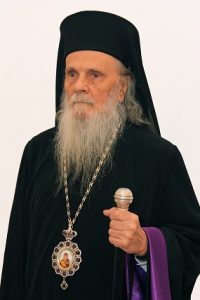
    “I wished from the depth of my heart for this movie/clip not to have been made. I did not seek publicity, Never In My Life, but because you have decided, I could not refuse you and I cannot refuse anyone who has good and honest thoughts. I have tortured myself all night and I was planning not to come to the Rohia Monastery and to tell you that I do not wish to appear in this movie, but you said that this movie would be of use to the people. And this is what has determined me to go ahead with this movie, with a profound consideration to the ones who will watch it. I consider that I Am Not Worthy and I do not wish to praise myself. These are just some flashes from my modest and humble life of God’s Servant and the Servant of the faithful people” (This Is My Life YouTube – Romanian version)

    “This is my life”

    https://www.youtube.com/watch?v=4anB-7H7BTQ

    Quoted above is the introduction of a movie clip titled “This is my Life” posted on YouTube and for those who understand … this says it all. We have been so blessed to have known Archbishop Iustinian Chira, or as we and the whole population of Maramures and Romania knew him as “Saint Iustinian Chira“. We have known Archbishop Iustinian Chira personally for over 50 years and our personal experiences and blessings which we have received from His Grace, are a testimony of his Endless Love for the common, simple people. It is something from another world, a world which for an inexperienced and simple person like me, is hard to put into words. This is why in this article, with the blessings of our spiritual father, I will only attempt to translate, some of the testimonies of Archbishop Iustinian Chira himself, asking Lord Jesus Christ to help me in this endeavor. I only wish I could convey to you the Love, the Fire, the Simplicity in his traditional language which His Grace used, but as I cannot, I ask you to watch the video clips following the links included in this article, even though they are in Romanian, because the language of Love is the same in all languages, and this is how you will receive the blessings and full benefit of His Grace’s Holy words. As Archbishop himself said in one of his books (”Live Beautifully and in Joy”) to some pilgrims: “I bless you! This whole summer I want you to think about the Rohia Monastery. You know why? Because then you will receive the blessings of Bishop Iustinian” (pg. 73)

    Archbishop Iustinian Chira was born in a village called Plopis, on the morning of Pentecost Sunday, 28 May 1921, as all the church bells were ringing and when all the clergy attended the Holy Liturgy. Just the same, his departure was also on a Sunday, 30 October 2016, in the morning during the Holy Liturgy which His Grace loved to serve so much, which according to many of the Romanian Hierarchs was a testimony of his unshaken faith: “This is how God showed us how much He loves Archbishop Iustinian”. He recalled this moment with so much humility and joy and recalled the words of his mother as she explained to him on many occasions, that the midwife, whom everyone in the village respected tremendously having been considered somewhat of a saint, said a few times to the Archbishop’s mother “You have a son and he will be a great man”, almost as a prophecy. These words have spread in the entire village to this day. But, Archbishop Iustinian said with tears in his eyes: “I am embarrassed/hesitant to say this word today because I am afraid that I did not fulfill the prophecy of the midwife. Yes, with the rank, I am together with people who have certain distinctions, but “a great man” in the true sense of the word, I am afraid that I have not reached that state. This means to be a whole man, a true man because you can be a “great man” with the rank and a small man with nature. A “great man” has to be a man with a great soul, with a great character, and for this, I have fought all my life until now at the age of 85 and I am afraid that I still have not become one.” (This is My Life)

    “At the age of 16, his father passed away in a most peaceful, beautiful Christian way, asking Archbishop Iustinian to pick him up from the bed and put him down on the floor. His last words were “Take care of you mum” and then he asked Archbishop Iustinian to read the Paraclesis Prayer of Holy Mother of God (Intercessory Prayer). I kneeled next to my father and I started to read the Paraclesis from a very old book with my face on his chest and as I was reading I felt that my father was falling asleep. He fell asleep, he did not die. There was no sound, no sigh, no tremble. This is why the Paraclesis of Mother of God for me in a way is a comfort in good times and in bad times because through this Paraclesis, my father called the Mother of God and She assisted him in his death. Above all, I have the certitude that the Mother of God protects us. For us Christians (I will now tell you a big word) more than God himself is the Mother of God. Not because She is the same as God or because She is higher than God, no, but because She is “mother” and because She has the most noble feelings of a mother.

    For me God was present, I did not live in an empty, wild place without God, the angels were present, not in my imagination, they were invisible but present, I did not try to imagine how God was, and even though I was a child I knew that this was beyond us to try to understand. For me, the spiritual world was just as real as the material world. I was always governed by a nostalgic feeling of missing someone tremendously, desiring another space, another world. I felt exiled when I was a child and I cried many times, such sorrowful tears after this other world, which I did not know where it was and how it could be found. Being a child and alone in the mountains, I dreamt about it and I felt that this was not my world, the world of which I dreamt of. But in the end I have found it. I loved to read books. I would often isolate myself from the other children and I would take the herd of cows up in the mountains to pasture, in a place where there were lots of rocks and there I would build a room/space with those rocks and I would call it my monastery, even though I had never seen a monastery before. And the logs were my Altar. This was very dear to me, and there was something else that was very dear to me the nature. I loved the nature. The nights for me were the biggest delight, satisfaction. The sky full of stars. I loved to watch the sunsets, how the moon appeared, how the sun rised. I loved the seasons and I lived them to the full extent. I lived the spring with all its beauties, the summer nights with all its splendor, autumn I loved especially, it is in my character to taste those melancholic days of autumn. It is extraordinary how much the autumn season speaks to me. And winter covered in snow, it’s as if I see God descending down on earth with long white hair locks. This was a part of my childhood for which I praise the Lord.

    I wanted to enter the monastic life at the age of 16 but my parents did not allow me, not because they were not faithful, but they were hoping to have me as support in their old days and they have entrusted me with all their wealth. After my father’s departure, at the age of 20, I categorically decided to leave. I confessed this to the priest in my village and he spoke with the hegumen from the Rohia Monastery, Nifon Matei. Nifon Matei was a true Saint. He has departed from this world at a very young age of 32 years old as he was sick. He led a life of a true ascet, he was tall with long reddish hair, reddish beard, blue eyes, when people would see him they would think they saw Christ himself. He was a great hegumen cherished by the people. For my mother it was a deep wound, she did not want me to leave. It was very early in the morning, at dusk, when I decided to leave and my mother asked me where I was going and I said “i am going out”, as I was afraid that she will grab in her arms me and she would not let me go. I left, I stopped for a moment I bowed and I said, “never will I return back”.

    When I arrived in the Rohia village, as I got closer to the monastery I asked a man where the monastery was, and he replied in a cold voice “there, why do ask me“. For me, that was a shock because in my village everyone had lots of patience and I thought that at the monastery everyone had wings (living like angels). I continued my walk. I saw a building and I started to bow and praise the Lord. Then I realized that it was just an old abandoned building. It was dark and I started to despair, then all of a sudden I heard the singing of a rooster and I saw the monastery. I got off the path and I cut across the field. When I got there, I saw three people chopping wood in the yard of the monastery and the atmosphere gave me a negative impression. I told them that I have a letter for the hegumen. One of the people went to speak to the hegumen. He returned and told me to go inside as the hegumen was waiting to see me. When I went inside I saw two doors and I did not know where to go. I entered the door on the right. There, I saw a monk squatted without a beard, that was another shock for me, I expected the hegumen to be .. you know … with a beard and …. I gave him the letter and then he said, oh you are here to see the hegumen. He took the letter to the hegumen, came back and told me that the hegumen is waiting for me. I entered the room and I saw a man with an extraordinary radiance and light on his face. I told him that, as the priest explained in the letter, I wanted to come into the monastery. The hegumen said OK, you can stay and we will see. I repeated a second time, “you know, I want to become a monk” and I received the same answer “settled down and we will see”. I started to cry and I repeated a third time that I did not come here for a visit and that I wanted to become a monk. The hegumen stood up and came to me, hugged me and said Ok, Ok, we will accept you. I asked when and he replied: “now”. I left the room so happy, I was romping like a lamb. Then, I heard the beating of a “toque”. Suddenly all my negative impressions vanished, the whole horizon was filled with light and into my soul has descended a happiness and joy … which has not ceased to this day. This is how I started my monastic life on 12 March 1941.

    My mother at home was crying and everyone was trying to comfort her, asking her why she was crying and explaining to her that everyone from the village had gone on the front in the war whilst I was still here. She answered, “I would have been happier if he would have gone on the front because from there I would have still had a chance that he would have returned home, but from where he is now there is no chance”. After I have entered into the Rohia Monastery, I have begun to live my new life for God, which is entirely different to the life in the outside world. It is another world and only those will succeed who live it in a sincere way and are sure of themselves to go on this path. The path of the monastery, of brotherhood, of a monk, priest, is a road which takes you gradually to divinity. How far on this road can a person travel, it is yet to be seen. Some go just a few steps, some more, some arrive in spheres full of light and in the sphere of angels.

    The first temptation was my mother who cried for me until the day she died. She would come to the monastery with my two sisters, and she did not have the patience to come on the footpath, but from the valley she would cut across the field and climb the steep mountain on four legs calling out my name, Ion, Ion from far away but when she would reach the monastery, she would not come to talk to me, she was just happy to see me. At that time I was a priest and hegumen, I was together with the people, so she did not come close, she was just happy to see me.

    I lived through some very hard times of the history of mankind. I lived under the occupation of the Hungarian and then under communism. I had a proposal from a great personality, a westerner, French and he had great powers. He said; “would you like to leave, and I said firmly “No, I do not want to” and he was astounded. He said nobody has ever replied to him so firmly. It was not because I liked the regime, but because I do did have the “right” to do it. If I could take with me the whole country and its people to take them to a happier place I would, but for me to leave just for my own pleasure it would be a very defying act. Starting with 1949, the regime took very severe measures against the church and it has forbidden for Feasts to be celebrated at monasteries and churches. From that date, always in the eve of a Feast, the army “Securitate” (communist security agents) would surround the monastery to prevent the people from coming to church. In 1955 they changed the method, they have declared the area as being contaminated (hazardous). In those times, there was one incident worth recalling. In 1951 the brothers in the monastery and I did not stop the services. I pretended that we did not see what was happening around. We have started the prayers, but when we started to beat the toque and ring the bells, there was most likely an “Order” given to not allow, but the soldiers seemed to hesitate unwillingly to enforce it, and then all the people/faithful in the nearby forest seize the moment and flooded the courtyard of the monastery which quickly became full. After the service concluded, which was held in the church because we did not dare to hold it outside (the church at the monastery in those times was very small and very few people would fit in for which reason the Services would be held), I spoke with the priest who was next to me, Nifon, who was later imprisoned for 7 years, for helping other monastics living in the forests as no other people were not allowed to joining to the monastery. So, we spoke in the Altar for a few minutes and then we agreed we will go outside for 5 minutes while one of us will take confession and the other one will write some names down for commemoration. It was around 8.00 in the evening. The people cleared the way, I have entered into the hegumen’s quarters and Nifon went into the kitchen. Inside the house was pitch dark, because it was 8.00 evening. I sat down on the side of the bed in my office and I waited for Nifon to come back as we have agreed and to go back into the church. Outside you could hear the roar of the people/faithful. But suddenly I have woken up, but I did not open my eyes. I started to think, why am I sitting here on the bed like this and I am not laying down and sleeping as I normally would. Then still with my eyes closed I thought, because I only sat here for 5 minutes waiting for Nifon. I thought, what day is today, the Feast day of Holy Mother of God. But why don’t I hear the noise of the people from outside, what’s with the peace. When I opened my eyes the house was filled with light. I looked out the window and I saw Nifon coming out of the kitchen, yawning and stretching. He came quickly and said. “father hegumen forgive me, what could you possibly have done all night by yourself because I went to the kitchen I sat down on a bench and I fall asleep.” And I told him, the same thing has happened to me. We were talking about 12 hours. When we went outside we saw a woman with a blind child and she started to cry “Oh father what has happened? After you and the other father have entered the house, the Securitate came and chased all the people away” I was very marked by what happened. I told Nifon to beat the toque and ring the bells because it was 8.00 in the morning and we started the service as usual. People started to trickle in from the nearby forests, and the courtyard filled again. There was no more Securitate around. One month later I was in Tirgu Lapus visiting some clergy, and a young man from the Securitate called out to me and said “Oh father you are a very good/obedient man”. I asked in a harsh tone because that is how I used to speak to them in those times “why” and he said “because you did not come out on the eve of the Feast day, because if you would have come out I do not know if you would have ever seen the sun again”

    Another incredible moment of which I wanted to talk to you about, was a time when even I was placed on the list to be picked up, to be arrested, because the regime did not like the fact that the faithful would come to the monastery in such great numbers. I wasn’t guilty of anything. In the village there was a house where some very good, trustworthy people lived, a man called John and his wife. They did not have any children and the Securitate used to meet in their house. One evening the policemen received an order to come up to the monastery and pick me up/arrest me. The policemen left and the man with his wife were very concerned because they loved the hegumen of the monastery which was Iustinian, so they went down on their knees and they began to pray. After a while the policemen and his help came back and said to the people that they went all the way up to the last bench in front of the monastery, but they could not go any further. Then they had to report this to the their superiors. They sent even more people from the Securitate, and they started to scold the policemen, asking them if they were children. They said; “let’s go together”. When they left the house the people again fell down on their knees and started to pray. They have all climbed the mountain and returned home later and said the same thing. We went all the way up to the last bench towards the monastery and we could not go any further. They have in turn reported the incident to the regional office. From there other higher ranked Securitate officers were sent over, and asked “are you all crazy, have you all become mystics?”. Then they tehmselves left heading towards the monastery, while the people remained in the house and prayed. The officers returned and said the same thing in awe, they climbed all the way up to the last bench and they could not get any closer to the monastery. This was clearly God’s work, because God knew that He needed a man here who had to continue with the Services. Archbishop Iustinian continued with tears in his eyes “This is how it is explained that I was not arrested. I was not worthy to die in the bottom of a prison, as did a lot of the other confessors, the elite, the cream of the Romanian nation. I was not worthy to be a martyr. But then I was a martyr serving and working for God and waking up people’s conscience. I formed a coenobitic, I raised 24 monks. Then, a law was issued in 1959 by the government, Law 410, by which were kicked out/evacuated from all the monasteries all the monks and all the nuns and they only allowed the very old, the sick and frail to remain. They have done this in stages, first the young, then the ones who did not complete grade seven, and in the third round the best monks, which is where I was too. So, on 1 June 1959 there was an Order for me to be kicked out. I did not leave. I had there a priest named Octavian Butur who was sent here to repent from a weakness he had (“drinking”) and he was thrown out by his wife, his mother, his parents and family and he stayed here for one month. When he arrived I told him, please I want you to understand that you did not come here as an exiled/punished, you came here as my guest as a friend. One month later, after he fulfilled his canon, and he went to Cluj to the bishop with whom he was colleagues while studying theology. Butur was chief of that promotion. He was a man of great capacity. He entered in the middle of a meeting, he told the bishop that he fullfilled his canon and that he was very happy because he got rid of his weakness of drinking. The bishop said that he was happy, but he had some very sad news, namely that he has received an order to kick out hegumen Iustinian. Butur said; “you have to intervene, because if you don’t I will pour a can of petrol all over me in front of the cathedral and I will leave in writing that I have committed suicide because hegumen Iustinian was kicked out of monastic life”. The bishop was terrified and he wrote a memorandum to Bucharest in which they have asked them to allow me to stay here, but I did not receive anything in writing, I did not know anything. But then the authorities started to come around to bribe me, please make a request to leave/be transferred, because we will give you the opportunity to occupy any position you wish. I told them that I will not do that. The Secretary from Lapus used to tell his colleagues ”I will go and shoot him” and they would all become terrified, only when he arrived in front of me he changed totally. One of his collaborators said what happened there was like King Michael the Brave – “one goes there like a wild animal but when he comes before the hegumen Iustinian he drops his axe, and does nothing”. Then, the First Secretary would turn the page and accuse me: “you are not on our side, why don’t you listen”. I asked him are you a member of the (Communist) Party, and the offended Secretary replied “what do you mean” I am the First Secretary, of course, I am. Yes ,Yes , I repeated are you a member, he answered “of course I am”, so do you do whatever you want or what the Communist Party orders you? “Of course I do what the Communist Party orders me”. Then, I said; “please allow me”. Not your Order! I have my own Party, and if it will order me to come as a pig herder for the Communist Party, I will come and I will have the same dignity/honour in my behaviour as I do here in the monastic life, because I will still be in the service of God, but with an order from my Leaders, not yours. The things I am telling you are incredible, totally out of the ordinary. Behold, God still performs miracles. The last series of monks were kicked our on 1 November 1959. With tears in his eyes, crying Archbishop continued “We have served the last Mass together, we have hugged each other and they have left, and I was left alone in front of the monastery. It was late dark, and they have left, some towards Lapus, some towards Boiereni and I have heard them as they were talking and getting further and further away and I was left alone and I lived alone crying, howling through these forests for many weeks, because I missed the ones who left me. On the other hand, my great comfort was that God has not left me, as God sent me even more faithful people than before and they have me close to their hearts, and every day more and more faithful people came and this was a big joy for me. Then, I dared to ask the bishop for some help, so two of the monks have returned. One was Deacon Bude Teodor, who has tonsured into monasticism by the miracle of Mother of God. As he was in the hospital, on his deathbed, the doctors wanted to send him home and told his father to go home and prepare the coffin because his son will not recover. He said that in that time the Holy Icon of Mother of God from Rohia, which we consider it to be a miracle making Icon, appeared in front of him and he made a promise, he said: “please give me life and I will serve you”. His father left the hospital and the Deacon started to improve and feel better and better. Then, he caught the public transport and went home. He arrived at night time and knocked at the door and his parents were afraid of him because they thought it was his spirit. Then, he came to the monastery and asked to be received, but I said: “we can not receive you because we do not have any food, there’s too many of us already”. Then he cried and said; “I will not leave because I promised the Mother of God” and so I received him.

    The story you have just heard me telling, about the Mother of God, is not a legend is a reality. As I said, on that Sunday when all the coenobitic have left, I was left alone with the cook and three other villagers who came to do some work on the field. Then, the cook went in the village and I went to the kitchen which was in the basement and I began to peel some potatoes to help the cook with the preparation of the food for the village workers. While I was peeling the potatoes, I heard very clearly, the footsteps of a person walking towards my office crying very loud. It was a woman. (the office was above the kitchen and the floor, or ceiling of the basement was a traditional wooden floor, making it very easy to hear footsteps or any noises upstairs). It was now very early in the morning. I dropped all the things and wondered what could have happened to this woman that she was crying so loud and came this early in the morning to the monastery. I went upstairs, in front of the house, but there was no one, then I went to the office and I could not see anyone, then I went in the next room, and then the next room. The cry was so real that I could not forget it or think that nobody was there. Then, I went in the church, in the Altar, around the church, in the courtyard, I was so convinced of the presence of this woman that I could not believe… Then I realized, it was the second day after the departure of all my brothers and reached the conclusion that She was the Mistress/Protector of the house, the Mother of God.

    The history of how the monastery was founded

    “The priest in the village Father Gherman had a young daughter, 10 years of age, who passed away. She always used to appear in her father’s dreams and asked him to build a house for the mother of God in the hill of the Vines. The priest, on every Sunday, used to make services for the dead. Everyone started to think that the priest has gone mad because he had eight other children and he was only commemorating the dead. He did not tell anyone about his dreams because he did not want everyone to think that he was crazy. After a while, one Sunday morning the priest was together with his wife, the children and the deacon, and a woman came to him, Floare Ilie and addressed the priest directly. “Father, why don’t you want to do what Anuta your daughter is asking you to do?” (this woman Floare, was very well known in the village because of her gift; she used to tell people things about themselves that nobody else knew). Because the priest wanted to be sure, he asked her to confirm “what does Anuta ask me to do”, and she told him to build a house for the Mother of God. Then the priest testified to everyone that, that’s exactly what he was draming about the whole summer, but he did not understand. The priest wanted to verify again and he asked what exactly do I need to do? “to build a house for the Mother of God on the hill of the Vine, a monastery father why don’t you understand”. She said exactly the same words as his daughter Anuta was saying to him in his dreams. The priest said to the lady, ”I am happy Aunty Floare that you came to us and I will do that”. That moment Father Gherman felt a great burden, pressing so hard on his shoulders he felt all summer, lifted as if the sky and everything around has lit up. He spoke to the deacons and they climbed up the hill and chose a place, which they marked with a cross made of two pieces of wood. Following day, when the priest came, he did not find the cross in the spot where they put it. They saw it on the top of a cliff. They took it back to the spot which they chose, but following day the same thing happened and so this has repeated many times, until an elder from the village named Alexandru Pop a man who was wise and educated said to the priest that he would like to guard the cross that night just in case somebody was trying to make fun of them. Father Gherman agreed and left him there. Alexandru stayed there until very late at night when the snow started to fall. Then, he went home and came back very early next morning. When he arrived there, the cross was missing and he spotted it in the same place as before on the cliff, only the problem was that there were no footsteps in the snow. Alexandru understood what has just happened and he was so overwhelmed by this incident/miracle that he paralyzed on the spot. He crawled back to the village, where he arrived only in the afternoon and then he told everyone the news. This is when the works for the building of the monastery started in 1923.

    My best friend since childhood was the Holy Bible and the books. These helped me accumulate knowledge so that I can serve God better. I was not interested only in theological issues but all the essential problems. I lived life with the greatest tremble knowing that we are surrounded by infinity, that we have in front of us eternity (the eternal life) and I sought all the paths/ways so that I would not get lost in this infinite unknown to us and lose the eternal life. Because if this life is hard for us, as I told the imprisoned people from the Baia Mare Prison, when I served the Holy Liturgy there, I told them that their life in prison is hard, but this will help them clean/get rid of their sins from this world, and to escape from the prison of hell, which is so much more worse. That’s why it is not logical for someone who wants to commit suicide. They do not realize that the sufferings from here are infinitely smaller than the sufferings from hell.”

    “This is my life. I have not been in any way better than you, than all of you, but I have fought to listen to God, and God has repaid me in abundance. I did not deserve all the goodness that God has bestowed upon me. God carried me by my hand all my life.”

    “I thank God because He has helped me to help you, all the people, with the thoughts, with the words, with the prayers, with love… with love.”

    Resources

    • https://www.youtube.com/watch?v=ciS-ezQmxIQ
      “I do not want to go to Heaven alone !!! God !!! I do not want to go to heaven alone! I want to go with all the people! I want you to know that I will not enter the gate of heaven until I see you all in Heaven!”

      Minute 2.36

      “Life does not end !!! Life does not end in 50-60 years. God has created us with an eternal soul. We will pass from this life to eternal life, where we will leave. We were born not to die, ever. We were born on earth to leave as God’s children.”

    • https://www.youtube.com/watch?v=uQx_Jr7XzVQ
      Minute 8.46

      “For me, any distinction I receive is a “Cross” not a gift. Any distinction is a “Cross”. From now, because the Holy Synod and the Patriarch have bestowed upon me this distinction of Archbishop…” Archi” means the oldest, this is what Archi means and that’s why from now on I will be the oldest amongst all of you. I am the first one who will depart(this prophecy was made 3 years in advance just the same as at His Grace’s last birthday this year May 2016, as detailed in a link below, His Grace said that: ”You found me in a unique moment. I believe that a second such moment I will not reach”), I am at the end of my road, but I will not forget you. I will stay at the gate of Heaven and I will wait for you all to arrive there. Because I will ask God, Where are the ones who are not present here? From now one I feel indebted. If up until now I have prayed a little, If I have fasted even less, if I gave alms to the poor even more less, from now on, I am indebted to pray more, to give more alms. From now on, we should not forget to pray more for each other. I wish you all a Merry Christmas !”

    • https://www.youtube.com/watch?v=jUCJUS1UNgg
      Minute 0.00

      “We are weak and Lord our Saviour says ‘Without me, you can not do anything” This thing we know and recognize “Without God, we can not do anything !!!

      Minute 0.36

      “For seventy years, I have always wept, because I have not done what I was supposed to do and how much I was supposed. I have always fought not to lose this cherished patience or humility.”

      Minute 1.13

      “My masters have been, from the beginning of my life, God and the faithful Romanian people. This is whom I have served during my 70 years of monastic life. I have tried to serve them with loyalty in good days and in bad days.”

      Minute 2.02

      “A servant of the church, a servant of God is not satisfied only if he prays for himself, or his friends, or institutions. A servant of the Orthodox church prays for all the living souls. And I pray to God to grant my prayer, for hell to be empty and heaven to be full of the children of Adam !”For every Holy Liturgy that Archbishop Iustinian served, the yard of the monastery would be full. People would come to hear the words full of Love of their bishop.

      Minute 2.28

      “God, please heed to my prayer. I do not ask anything for myself. But, I do not want to go to heaven alone ! I do not want to go to heaven alone ! I do not want to go to heaven alone ! God, I do not want to go to heaven alone ! I want to go with the whole nation, all the people. I want you to know that I will not enter the gate of heaven until I will see you all in heaven. Do not forget ! This is my wish at the age of 90, for God to grant your prayers. I have spoken a little, because I do not know if next year I will still be alive, or have strength. But I was happy that I came to pray together with all of you, to gaze upon you as I would gaze upon the Holy Icons.”

      Even though the Archbishop would spend whole days and night in prayer, his humility was one of his many virtues.

      Minute 4.12

      “I wish and I pray day and night, thinking about the people of God. Day and night I spend thinking about God and about the faithful people. The Charity, The Prayers, and The Fasting; these deeds, Lord Jesus Christ names as being the deeds of our righteousness. If we will respect these deeds, we will find the righteousness of God, which will grant us our rewards.”

    • https://www.youtube.com/watch?v=g_RVh3TtOAM
      Miracles:

      • When the relics were brought into the Cathedral for the Services, a smile appeared on Archbishop Iustinian Chira just the same as in the case of Saint Elder Joseph of Vatopedi
      • The glass from the coffin above the mouth was steamed
      • Archbishop Iustinian Chira opened his eyes when lowered into the tomb


    • https://www.youtube.com/watch?v=-_2N_q62LIY
      This clip is about the Rohia Monastery where Archbishop Iustinian first entered into the monastic life and later became hegumen. Encompassed here, there is a clip from an old documentary which was filmed by an English reporter in 1978.

      Minute 5.16

      “If God who made the sky and the earth, has fought and did everything possible to save us from hell, to help us reach salvation. This means, that these realities are terrible. Us people with our minds can not comprehend this. Even you, now as talk to you. You are floating… and the majority…are wondering, What is it? How is it going to be? We have very limited means of perception. What can we understand about the eternal darkness? But we understand from deeds. If The Merciful God did everything possible to save mankind from the slavery of hell and darkness, then it means that this is a very serious problem.”The hidden treasure of the Rohia Monastery is the Library which is one of the most important libraries in Transilvania. Here in safekeeping are 170 manuscripts of Archbishop Iustinian Chira, which are solemnly guarded.

      Minute 13.00

      “A sea of people dressed in traditional clothing, man, women, children, and a Bishop. In 1978 the whole Occident would see a documentary about Orthodoxy and authentic Romanian living. It was during the full Communism Regime. (*the clip is in English so you can listen to the testimony of the English reporter)Archbishop Iustinian : “Christ has Risen !”
      The People : “In Truth He has Risen !

      Minute 13.10

      “It was here in Cluj that I first saw the churchman who was going to unsettle me more than any other in Romania. I even started to think of him as in some curious way, my adversary. He was a Bishop called Iustinian Chira. It is alright when Icons stay within the frames, but when they move at you, it is quite worrying.The filmmakers of the documentary were intrigued by the personality of Bishop Iustinian who talked to them without any hidden agendas, clear and with authority, demoting all the preconceptions about the Romanian culture and faith.

      Minute14.40

      “35 Years have passed since the making of this movie and about Archbishop Iustinian have been written books, in which they talk, many times, not about a Holy man, but about a Saint. Iustinian Chira is now an Archbishop. He is 91 years old and is the Sheppard of the faithful people of Maramures.”

      Minute 14.50

      “I am happy that you have arrived in Maramures !”

      “I was emotional. I was meeting a protector of our faith. A man of whom they say talks to God. A man who was a clairvoyant.

      “Some praise you that you are very good and others that you are very bad. Who’s right? Neither. You are not very good and you are not very bad. Man, is as God intended him to be. In other words, we all have these two categories. We are all saints and people with weaknesses. As followed, was a meeting of 5 hours.”

      “Here, I just received (some books), do you want them?”

      “Of course, I want them, I will not give them back. We came to meet a Saint and we found a child with long hair locks and long bearded. A wise old man with the soul of a child, happy to show us around the place where he leaves.”

      All these things, I do not waste them because I have received as a present and presents should not be wasted because it is our duty.This is how you gather a treasure.”

      “He held onto my hand and walked slowly, but when he talked about God and the holy books, he was a different man he gained life.”

      “A reporter asked a woman from the south, where you come from and he said tell me, aunty, what are we celebrating at Christmas? And what did she answer? “ Oh, at Christmas we cut the pig. What about easter? and she answered Oh we cut the lamb. That’s how much your Christian knew. This is the lack of education and the profound absence of Christian educations !! The Mahomedans hold their faith very dear to them, body and soul, isn’t’ it, jews the same and the Buddhists the same, and us Christians are in deficit. Please forgive me, I do not raise my voice at you and your weaknesses. I raise my voice at the weaknesses of mankind. We are Christians and we are not able to embrace the great mystery of Christianity. Look, these books were published during the Communism Regime. While the church was mocked and destroyed I wrote an article about the church. In Maramures, he is loved by the people because he calls things by their names.”

      “I use to see from my bedroom window how the workers were walking around with an empty bag and could not find a piece of bread in the whole town of Cluj. Then during the Holy Liturgy/Sermon in June 1989, I said “May God grant the prayers and burn the chair of the one who starves this nation and disrespects the workers. It was in public, full of Securitate Agents dressed as civilians and what did they say? Ohh, this bishop, may God curse him, tells us…he makes our skin sting, but what can we do?! Nothing because he is right! This was the occupation! this is what it was brother ! Dear, let me give you a gift as well.(and again he becomes a child ). Pointing to a bell he said I will ask him to talk to you, and he started ringing the bell. This is their tongue.”

      Minute 32.40

      “This is the conclusion of the English reporter, it can be listened to in English.” When I am asked what I have brought back from Romania, I think about that walk. That I can not say much, I suppose it is my individual, untransferable, interior, unfolding Romanian Orthodox Icon.“

      “I asked him about the documentary from 35 years years ago. His Grace is convinced that it did Romania and the church a great service. His Grace remembers every word. He spoke to the Occidentals without a curtain, about Romanians and their faith. He was backed up by the people, who loved him. Even he is surprised that he was not punished by the Regime, but decorated. Who was president in 70’s? Ceausescu. Ei ! One of the decorations is from that time? Of course. I was astounded that they did not throw me in prison. Only, I was a man and even the devil respected me !!! even the demons respected me !!! Did you understand ?!!!”

      Minute 33.50

      For this reason, because he had an attraction to people, politicians used to seek him. “A politician came to see me because he wanted to become a Prime minister and asked me for advice. I was speaking with him just the same as I am speaking with you now, only more harsh, severe. In conclusion, he wanted a last word of advice. I said, Mr… this is the word I want to tell you. Everybody has to fulfill his duty!!! You Animal !!! if everybody would fulfill his duty from big to small, wouldn’t heaven be on earth?” (It was clear that Archbishop Iustinian was able to read everyone’s intentions)

    • https://www.youtube.com/watch?v=BTvyqNONjqI
      Minute 0.55

      “The prayer can reach so far, that it surrounds the whole world around. The sound of the bells from Rohia can reach up to the Orion constellation. The stars from the sky vibrate, from happiness. The song of the bells is a trumpet wich was invented by man, through which to bring praise to the Lord. Over seven decades of serving, thousands of Holy Liturgies and just as many words of advice. They have all been happy days/moments. Because I was in the monastery, I was in the Altar, I was with the people, I was with God. Filocalic wisdom, ascetic face, good and kind words, patient and sacrificing nature. This is the example/teaching of a life lived with dignity even though it was sprinkled with many trials. These have all made Archbishop Iustinian the firm, testifier, relentless in testifying the Romanian orthodoxy and our holy values.”

    • https://www.youtube.com/watch?v=IC9yMzczpT0
      This clip was recorded at the Service performed by two Bishops, honoring Archbishop Iustinian on the eve of Archbishop’s Iustinan Chira’s birthday this year on 27 May, 2016.”Your Graces ! You found me in a unique moment. I believe that a 2nd such moment I will not reach, this time I have reached this unique moment, in which I have seen you all gathered up and not just you, but also His Grace, the Metropolitan of Ardeal Andrei Andreicut, His Grace the future Bishop of Maramures, Iustin Sigheteanul, the whole clergy and you the faithful people. We have gathered here with pure hearts and souls to celebrate 95 years of life and I ask you to thank God, together all of us because God has helped me to live these 95 years and I have lived them fully. I have lived fully the spiritual life. That is why I thank God, first of all, the Father, The Son and The Holy Ghost, the Mother of God and all the Angels and Saints because they have helped us the servants of God and the whole nation. We are the representatives of a faithful, pious nation, a good and a Holy nation. That is why I am indebted to thank you all from the depths of my soul. I assure you and I want to testify that if God will give me the right to pray even after my departure from here, I will never forget you ! He said, with tears in his eyes, with a trembling yet very powerful voice: “The way I see you now, that’s how I will see you forever and ever, and I will pray to God for everyone’s Salvation !!! The whole nation, our Blessed nation, the whole country. All the servants !!! I see here a category of people, a beautiful attire, a blessed attire. The Military costumes. Distinguished people. People with great merits. The clergy and the army are two categories, which have and always had a unique role in the lives of humankind.””For everything, Your Grace (Metropolitan Andrei), I thank you with warmth. Please forgive my weaknesses because 95 years of age, however, have their say. The bones have aged, my mind is weaker, my sight is darker, cloudier, but my heart has remained alive. My heart has not aged, my soul has not aged and my body has not aged, at 95 years of age, because, just the same as my brothers who are wearing the monastic clothes, I had strong faith and hope in the power of God Who keeps this nation surrounded by all these strange (unfaithful) nations. Praise the Lord for everything. I thank you from depth of my heart, May Lord Jesus Christ Bless you all, the ones who are in the families, in parishes, in the hospitals, those who travel, but even those who are not here but in prisons, for everyone from the bottom of the soul I pray to Lord Jesus Christ. To comfort them all, and payment I do not have, one that you deserve. Payment I wait, to remind indebted forever to all of you, and I assure you that if God is righteous and merciful, everyone will find Heaven open because we are a faithful nation, a righteous nation, a holy nation. There is no other nation on earth, as the Romanian nation. 2000 years we have suffered here and we have not abandoned our ancestral hearth, we have not abandoned the Romanian laws and we have not abandoned those who were suffering. God Bless you all ! May God Bless the Romanian country! May God’s Grace, Power and Mercifulness Bless you all now and forever and ever Amin!””On a happy/cheerful note, which is very typical of Archbishop Iustinian Chira, at the end of the ceremony, His Grace complimented the young man next to him dressed in traditional costume, whom His Grace picked from the crowd anonymously, to help his Grace stand during the delivery of his Sermon. So, smiling he said:“I thank my brother and ask for his forgiveness for holding him back, because his face and his pants (using a very old jargon) are both of ours.” Then, His Grace kissed the young man on the head as he always did with so many other of the faithful.

    We thank those friends of ours that help put together this article. May God remember them in His kingdom.
  • Blessed Father Seraphim: The Orthodox Must Avoid Fanaticism and Sectarianism and Stay United in the Face of the “Council”

    https://orthodoxethos.com/post/blessed-father-seraphim-the-orthodox-must-avoid-fanaticism-and-sectarianism-and-stay-united-in-the-face-of-the-council

    fr-seraphim-rose

    Prophetic and Wise Words Which are So Very Relevant to Today’s Church

    Blessed Father Seraphim Rose has bequeathed much to the Church, not least of all his tireless witness to the royal path of the Fathers in the face of the general apostasy of our age and the particular heresy of our day, syncretistic ecumenism. In the following excerpt, from a letter her wrote on the feast of the translation of the relics of St. John Chrysostom, Jan 27/Feb. 9, 1977, Fr. Seraphim prophetically stresses the great need for Orthodox unity in the face of the challenge of the “Great and Holy Council”:

    “We pray that God will grant peace to his small flock, and that small differences of opinion will not destroy the unity of all who should be fighting against the real apostasy of our times—that represented by the frightful “Eighth Ecumenical Council,”* which seems to be drawing closer. In a way, we welcome this robber-council, for it will perhaps be so obviously anti-Orthodox that some will see it and withdraw from that ruinous path. That is another reason for the True Orthodox Christians to be not fanatical but moderate, holding a path of true Orthodoxy and not sectarianism in the face of such temptations.”

    There are several “take-aways” from these wise words of Fr. Seraphim:

    1. The unity of the Orthodox, those confessing faith in the “one, holy, catholic and apostolic Church,” is precious and we must not allow lesser differences to divide us.
    2. The real challenge, what he calls “the real apostasy,” of our day is syncretistic ecumenism and this is represented by the “Council” which is a robber-council.
    3. This false council is at once both a threat to the unity of the Church and an opportunity for many who have not seen or paid attention to this greatest of threats to see, understand and unite together in favor of Orthodoxy. This is precisely what we have seen happening since last January.
    4. In order to encourage this “awakening” and “unifying” it is very important for all Orthodox to avoid fanaticism and sectarianism in response to syncretistic ecumenism.

    This last point is perhaps the most important point of all, for many do not give weight to the “temptation on the right” and thus easily fall into it. However, it matters little to the enemy of our salvation if he snares us on the left or on the right, for both are falls from the “royal path” of the Fathers. It requires much humility, reflection, and discernment for the struggler to remain on the royal path of discernment of spirits in this day and age, in which it is the “standard” for two options to be offered and both of them to be erroneous. We often hear that you must either be for the “Council” or against Church unity. Or, you are either with the “ecumenists” or a fanatic and zealous “not according to knowledge.” However, these are false dichotomies. Those who speak this way are making the assumption that there are only two possible positions, both of them extreme. The question is posed in this way in order to force Orthodox Christians, who are naturally opponents of syncretistic ecumenism, into one of these two extreme positions — both of which are not the royal path of the Fathers.

    The simple answer is: we are following the Holy Fathers, we are in the Church and not innovators, and we will neither succumb to the extremism of fundamentalist ecumenism nor the trap of undiscerning zealotry, both of which work to undermine the unity of the Church.

    May all sincere Orthodox take to heart the wise words of Blessed Father Seraphim and focus on Christ and Him Alone, working together with all who rightly believe and confess, in order to build up the Church and Her unity.

    – Protopresbyter Peter Heers

    *At the time, the organizers and commentators of the Council were referring to it in this manner.